

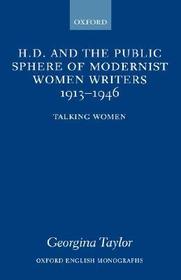
H.D. and the Public Sphere of Modernist Women Writers 1913-1946
Talking Women
Series: Oxford English Monographs;
- Publisher's listprice GBP 142.50
-
64 338 Ft (61 275 Ft + 5% VAT)
The price is estimated because at the time of ordering we do not know what conversion rates will apply to HUF / product currency when the book arrives. In case HUF is weaker, the price increases slightly, in case HUF is stronger, the price goes lower slightly.
- Discount 10% (cc. 6 433 Ft off)
- Discounted price 57 905 Ft (55 148 Ft + 5% VAT)
Subcribe now and take benefit of a favourable price.
Subscribe
64 338 Ft

Availability
printed on demand
Why don't you give exact delivery time?
Delivery time is estimated on our previous experiences. We give estimations only, because we order from outside Hungary, and the delivery time mainly depends on how quickly the publisher supplies the book. Faster or slower deliveries both happen, but we do our best to supply as quickly as possible.
Product details:
- Publisher OUP Oxford
- Date of Publication 31 May 2001
- ISBN 9780198187134
- Binding Hardback
- No. of pages240 pages
- Size 225x146x17 mm
- Weight 397 g
- Language English 0
Categories
Short description:
This book places H.D. (Hilda Doolittle) in the context of the wider network of women writers in which she participated. It examines the structures through which they exchanged ideas, such as the little magazines and anthologies, charting changes in focus by the network and the ways that new ideas emerged and were developed.
MoreLong description:
This book locates H.D. within an Anglo-American 'public sphere' of women writers, a discursive arena in which individuals come together in debate and discussion. The theoretical framework used is that outlined in Jürgen Habermas's The Structural Transformation of the Public Sphere, modified in order to consider this group as a 'counter-public sphere', a non-dominant group whose interests were non-identical to those of the dominant public sphere.
From 1913 a network of little magazines enabled women writers to come together in unprecedented numbers in public exchange. The ethos of this public sphere was a challenge to all convention, including challenges to the perceived sentimentality of earlier women's writing; H.D.'s Imagism was crucial in this. Initially this public sphere avoided engagement with the wider socio-political world, focusing instead on psychic reality. Writing became increasingly experimental in a new wave of avant-garde activity, fuelling heated debate in the magazines around the nature of 'literature'.
By the mid 1920s this particular literary sphere had lost direction, but continued to experiment and seek new ways forward. New discussions around cinematic forms (in which H.D. participated) kept critical discussion very much alive. In the 1930s the work emerging from this network was increasingly politically aware. This was a period of highly disturbed writing such as H.D.'s Nights and Djuna Barnes's Nightwood, internalizations of the sadomasochism enacted on the world stage.
After the war, this public sphere declined into personal exchanges in letters and private circulation of manuscripts.
... by examining modernism in relation to the public sphere Taylor's study challenges the way that 'modernism' itself has come to be understood.
Table of Contents:
A Theoretical Overview
1913-1917: The Genesis of a Public Sphere
1918-1924: Expansion and Consolidation - New Experiments in the Public Sphere
1925-1931: Incubation
1932-1946: Responses to a World in Crisis
Postscript
Conclusion
Bibliography

