

- Publisher's listprice GBP 84.00
-
40 131 Ft (38 220 Ft + 5% VAT)
The price is estimated because at the time of ordering we do not know what conversion rates will apply to HUF / product currency when the book arrives. In case HUF is weaker, the price increases slightly, in case HUF is stronger, the price goes lower slightly.
- Discount 10% (cc. 4 013 Ft off)
- Discounted price 36 118 Ft (34 398 Ft + 5% VAT)
Subcribe now and take benefit of a favourable price.
Subscribe
40 131 Ft

Availability
printed on demand
Why don't you give exact delivery time?
Delivery time is estimated on our previous experiences. We give estimations only, because we order from outside Hungary, and the delivery time mainly depends on how quickly the publisher supplies the book. Faster or slower deliveries both happen, but we do our best to supply as quickly as possible.
Product details:
- Publisher OUP USA
- Date of Publication 4 June 1998
- ISBN 9780195114485
- Binding Hardback
- No. of pages224 pages
- Size 132x160x30 mm
- Weight 340 g
- Language English 0
Categories
Short description:
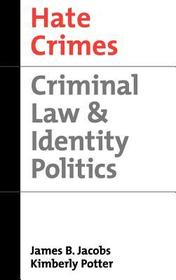
This book is an in-depth critique of the USA's dominant political and legal response to "hate crime". The authors show how the media and politicians have constructed a hate crime epidemic without any solid evidence to support it. They argue that hate crime laws make no sense from a law enforcement or criminal justice standpoint, but are only comprehensible as symbolic politics. The well-intentioned effort to denounce prejudice motivated crime may end up dividing the community rather than bringing it together.
MoreLong description:
Early in the 1980s, a new category of crime appeared in the criminal law lexicon. In response to what was said to be an epidemic of prejudice-motivated violence, Congress and many state legislatures passed a wave of "hate crime" laws that required the collection of statistics and enhanced the punishment of crimes motivated by certain prejudices. This book places in socio-legal perspective both the hate crime problem and society's response to it. From the outset, Jacobs and Potter adopt a sceptical if not critical stance. They argue that hate crime is a hopelessly muddled concept and that legal definitions of the term are riddled with ambiguity and subjectivity. Moreover, no matter how hate crime is defined, the authors find no evidence to support the claim that the US is experiencing a hate crime epidemic--nor that the number or rate of hate crimes is at an historic zenith. Furthermore, assert the authors, the federal effort to establish a hate crime accounting system has been a failure.
The authors argue that hate crime as a socio-legal category represents the elaboration of an identity politics that manifests itself in many areas of the law. However, the attempt to apply the anti-discrimination paradigm to criminal law generates a number of problems and anomalies. The underlying conduct that hate crime law prohibits is already subject to criminal punishment. Jacobs and Potter maintain that there is no persuasive rationale for saying that hate crimes are "worse" or "more serious" than similar crimes attributable to other anti-social motivations. Also, they argue that the effort to single out hate crime for greater punishment, in effect, is an effort to punish some offenders more seriously because of their bad beliefs, opinions, or values, thus implicating the First Amendment.
Jabobs and Potter show that the recriminalization of hate crime has little (if any) value with respect to law enforcement or criminal justice. Indeed, enforcement of such laws may in fact exacerbate intergroup tensions rather than eradicate prejudice.
... contains compelling and insightful evidence regarding the place and role of criminal law in dealing with hate crime.

