

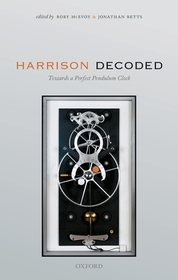
Harrison Decoded
Towards A Perfect Pendulum Clock
- Publisher's listprice GBP 84.00
-
37 926 Ft (36 120 Ft + 5% VAT)
The price is estimated because at the time of ordering we do not know what conversion rates will apply to HUF / product currency when the book arrives. In case HUF is weaker, the price increases slightly, in case HUF is stronger, the price goes lower slightly.
- Discount 10% (cc. 3 793 Ft off)
- Discounted price 34 133 Ft (32 508 Ft + 5% VAT)
Subcribe now and take benefit of a favourable price.
Subscribe
37 926 Ft

Availability
printed on demand
Why don't you give exact delivery time?
Delivery time is estimated on our previous experiences. We give estimations only, because we order from outside Hungary, and the delivery time mainly depends on how quickly the publisher supplies the book. Faster or slower deliveries both happen, but we do our best to supply as quickly as possible.
Product details:
- Publisher OUP Oxford
- Date of Publication 28 April 2020
- ISBN 9780198816812
- Binding Hardback
- No. of pages192 pages
- Size 224x145x18 mm
- Weight 426 g
- Language English
- Illustrations 82 illustrations 0
Categories
Short description:
This book is an exposition of the lesser-known work of one of the giants of the 18th century longitude story, the maverick clockmaker John Harrison (1693-1776). Harrison's background, methodology, and thinking. For those with a practical interest, the book is an excellent starting point for anyone wishing to make a clock of this type.
MoreLong description:
Brings together the output of a forty-year collaborative research project that unpicked and put into practice the fine details of John Harrison's extraordinary pendulum clock system. Harrison predicted that his unique method of making pendulum clocks could provide as much as one-hundred-times the stability of those made by his contemporaries. However, his final publication, which promised to describe the system, was a chaotic jumble of information, much of which had nothing to do with clockwork. One contemporary reviewer of Harrison's book could only suggest that the end result was a product of Harrison's 'superannuated dotage.'
The focus of this book centres on the making, adjusting, and testing of Clock B which was the subject of various trials at the Royal Observatory, Greenwich. The modern history of Clock B is accompanied by scientific analysis of the clock system, Clock B's performance, the methods of data-gathering alongside historical perspectives on Harrison's clockmaking, that of his contemporaries, and some evaluation of the possible influence of early 18th century scientific thought.
This is an intriguing book that anyone interested in clocks and their history will enjoy.
Table of Contents:
Introducing the precision pendulum clock
The origins of John Harrison's 'Pendulum-Clock' technology
Introducing Martin Burgess, clockmaker
Rescuing Martin Burgess's Clock B
Reflections on making clocks Harrison's way
Completing Clock B
Adjusting and testing Clock B at the Royal Observatory, Greenwich
Crunching the numbers: analysis of Clock B's performance at Greenwich
Decoding the Physical Theory of Harrison's Timekeepers
Analysis of the mechanisms for compensation in Clock B
Update on Clock B

