

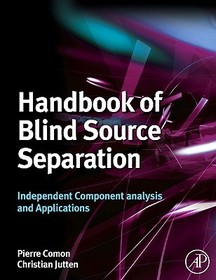
Handbook of Blind Source Separation
Independent Component Analysis and Applications
- Publisher's listprice EUR 124.00
-
48 434 Ft (46 128 Ft + 5% VAT)
The price is estimated because at the time of ordering we do not know what conversion rates will apply to HUF / product currency when the book arrives. In case HUF is weaker, the price increases slightly, in case HUF is stronger, the price goes lower slightly.
- Discount 10% (cc. 4 843 Ft off)
- Discounted price 43 591 Ft (41 515 Ft + 5% VAT)
Subcribe now and take benefit of a favourable price.
Subscribe
48 434 Ft

Availability
printed on demand
Why don't you give exact delivery time?
Delivery time is estimated on our previous experiences. We give estimations only, because we order from outside Hungary, and the delivery time mainly depends on how quickly the publisher supplies the book. Faster or slower deliveries both happen, but we do our best to supply as quickly as possible.
Product details:
- Publisher Elsevier Science
- Date of Publication 6 April 2010
- ISBN 9780123747266
- Binding Hardback
- No. of pages856 pages
- Size 246x188 mm
- Weight 1920 g
- Language English 0
Categories
Long description:
Edited by the people who were forerunners in creating the field, together with contributions from 34 leading international experts, this handbook provides the definitive reference on Blind Source Separation, giving a broad and comprehensive description of all the core principles and methods, numerical algorithms and major applications in the fields of telecommunications, biomedical engineering and audio, acoustic and speech processing. Going beyond a machine learning perspective, the book reflects recent results in signal processing and numerical analysis, and includes topics such as optimization criteria, mathematical tools, the design of numerical algorithms, convolutive mixtures, and time frequency approaches. This Handbook is an ideal reference for university researchers, R&D engineers and graduates wishing to learn the core principles, methods, algorithms, and applications of Blind Source Separation.
MoreTable of Contents:
Introduction; Information; Contrast functions; Likelihood; Algebraic methods after prewhitening; Iterative algorithms; Second order methods based on color; Convolutive mixtures; Algebraic identification of under-determined mixtures; Sparse component analysis; Quadratic time-frequency domain methods; Bayesian approaches; Non-negative mixtures; Nonlinear mixtures; Semi-blind methods for communications; Overview of source separation applications; Application to telecommunications; Biomedical applications; Audio applications
More
