

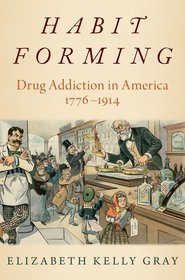
Habit Forming
Drug Addiction in America, 1776-1914
- Publisher's listprice GBP 29.49
-
13 314 Ft (12 680 Ft + 5% VAT)
The price is estimated because at the time of ordering we do not know what conversion rates will apply to HUF / product currency when the book arrives. In case HUF is weaker, the price increases slightly, in case HUF is stronger, the price goes lower slightly.
- Discount 10% (cc. 1 331 Ft off)
- Discounted price 11 983 Ft (11 412 Ft + 5% VAT)
Subcribe now and take benefit of a favourable price.
Subscribe
13 314 Ft

Availability
Estimated delivery time: In stock at the publisher, but not at Prospero's office. Delivery time approx. 3-5 weeks.
Not in stock at Prospero.
Why don't you give exact delivery time?
Delivery time is estimated on our previous experiences. We give estimations only, because we order from outside Hungary, and the delivery time mainly depends on how quickly the publisher supplies the book. Faster or slower deliveries both happen, but we do our best to supply as quickly as possible.
Product details:
- Publisher OUP USA
- Date of Publication 9 February 2023
- ISBN 9780197646694
- Binding Paperback
- No. of pages352 pages
- Size 236x157x23 mm
- Weight 481 g
- Language English
- Illustrations 8 black and white illustrations 278
Categories
Short description:
Habit Forming explores American drug addiction and recreational drug use from 1776 to 1914, providing important historical context for the ongoing War on Drugs.
MoreLong description:
Habitual drug use in the United States is at least as old as the nation itself. Habit Forming traces the history of unregulated drug use and dependency before 1914, when the Harrison Narcotic Tax Act limited sales of opiates and cocaine under US law. Many Americans used opiates and other drugs medically and became addicted. Some tried Hasheesh Candy, injected morphine, or visited opium dens, but neither use nor addiction was linked to crime, due to the dearth of restrictive laws. After the Civil War, American presses published extensively about domestic addiction. Later in the nineteenth century, many used cocaine and heroin as medicine. As addiction became a major public health issue, commentators typically sympathized with white, middle-class drug users, while criticizing such use by poor or working-class people and people of color. When habituation was associated with middle-class morphine users, few advocated for restricted drug access. By the 1910s, as use was increasingly associated with poor young men, support for regulations increased. In outlawing users' access to habit-forming drugs at the national level, a public health problem became a larger legal and social problem, one with an enduring influence on American drug laws and their enforcement.
Habit Forming: Drug Addiction in America, 1776-1914 is a unique and unreservedly recommended addition to community and academic library History of Medicine/Addiction collections and supplemental curriculum studies lists.
Table of Contents:
Acknowledgments
Note on Terminology
Introduction
Part I: Hidden Drug Use in America
Chapter 1: American Use of Opiates, 1776-1842
Chapter 2: American Drug Use Quietly Escalates, 1842-1867
Chapter 3: The Vogue for Hashish, 1832-1884
Part II: Learning from a World of Users
Chapter 4: The Global Context, 1774-1862
Chapter 5: Habitual Opiate Use in Great Britain, 1821-1877
Chapter 6: The Drug Trade and Habitual Use in China, 1804-1881
Part III: An Open Problem
Chapter 7: American Opium Dens, 1850-1910
Chapter 8: A Public Problem, 1867-1905
Chapter 9: Federal Regulation Begins, 1875-1914
Conclusion: The Hydra Emerges
Notes
Bibliography
Index

