

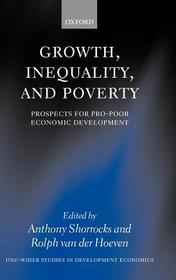
Growth, Inequality, and Poverty
Prospects for Pro-poor Economic Development
Series: WIDER Studies in Development Economics;
- Publisher's listprice GBP 83.00
-
37 474 Ft (35 690 Ft + 5% VAT)
The price is estimated because at the time of ordering we do not know what conversion rates will apply to HUF / product currency when the book arrives. In case HUF is weaker, the price increases slightly, in case HUF is stronger, the price goes lower slightly.
- Discount 10% (cc. 3 747 Ft off)
- Discounted price 33 727 Ft (32 121 Ft + 5% VAT)
Subcribe now and take benefit of a favourable price.
Subscribe
37 474 Ft

Availability
printed on demand
Why don't you give exact delivery time?
Delivery time is estimated on our previous experiences. We give estimations only, because we order from outside Hungary, and the delivery time mainly depends on how quickly the publisher supplies the book. Faster or slower deliveries both happen, but we do our best to supply as quickly as possible.
Product details:
- Publisher OUP Oxford
- Date of Publication 4 March 2004
- ISBN 9780199268658
- Binding Hardback
- No. of pages300 pages
- Size 242x164x22 mm
- Weight 604 g
- Language English
- Illustrations Figures and tables 0
Categories
Short description:
This is a collection of papers examining the pressing issue of increasing inequality in the distribution of income in developing countries. While economic growth is a prerequisite for a sustained reduction in poverty, policies aimed at raising growth rates are often associated with a range of adverse short term effects, including rising unemployment, greater economic insecurity, environmental degradation and the weakening of traditional social safety nets. Pro-poor growth strategies attempt to address these short term problems. But the ideal mix of policies, and their impact on the prospects for poverty reduction in the longer run, remain controversial topics. Growth, Inequality and Poverty comprises many of the most important contributions to the current debate.
MoreLong description:
The relationship between growth, inequality, and poverty lies at the heart of development economics. This volume draws together many of the most important recent contributions to the controversies surrounding this topic.
Some of the chapters help explain why there is profound disagreement on crucial issues of growth, poverty and inequality within academic circles, and among organizations and various groups active in the development field. Another central theme is the cross-country evidence on the relationship between growth and poverty, and the extent to which it is valid to draw policy conclusions from this empirical evidence. The volume also shows how new microeconomic techniques such as poverty maps and microsimulation models can be used to improve poverty analysis and the design of pro-poor policies.
The overall conclusion points to the need for diverse strategies towards growth and poverty, rather than simple blanket policy rules. Initial conditions, specific country structures, and time horizons all play a significant role. Initial conditions affect the speed with which growth reduces poverty and can also determine whether policies such as trade liberalization have a pro-poor or an anti-poor outcome. Improved education is valuable in itself, and also contributes to poverty reduction; but its effect on inequality depends on supply and demand factors, which differ significantly across countries. Likewise, the quantitative impact on poverty of redistribution from the rich to the poor vis-à-vis an increase in total national income can vary greatly across countries. Hence the need for creative approaches to poverty which take full account of the specific circumstances of individual nations and which assign a central role to inequality analysis in the discussion of poverty-alleviation policies.
There is no more important issue in development economics and perhaps even for the future of mankind than the interrelationship among growth, inequality and poverty. This is a very important book which goes a long way in clarifying this interrelationship and outlining the elements of a pro-poor development strategy.
Table of Contents:
Economic Policy, Distribution, and Poverty: The Nature of Disagreements
Growth is Good for the Poor
Growth, Inequality, and Poverty: Looking Beyond the Averages
The Growth Elasticity of Poverty
Education is Good for the Poor: A Note on Dollar and Kraay
Growth, Distribution, and Poverty Reduction: LDCs are Falling Further Behind
Redistribution Does Matter: Growth and Redistribution for Poverty Reduction
Producing and Improved Geographic Profile of Poverty: Methodology and Evidence from Three Developing Countries
Twin Peaks: Distribution Dynamics of Economic Growth Across Indian States
A Decomposition of Inequality and Poverty Changes in the Context of Macroeconomic Adjustment: A Microsimulation Study for Côte d'Ivoire
Educational Expansion and Income Distribution: A Micro-Simulation for Ceará
Growth, Income Distribution, and Poverty: A Review

