

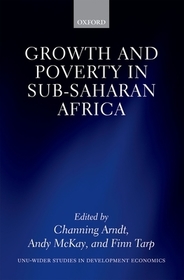
Growth and Poverty in Sub-Saharan Africa
Series: WIDER Studies in Development Economics;
- Publisher's listprice GBP 112.50
-
53 746 Ft (51 187 Ft + 5% VAT)
The price is estimated because at the time of ordering we do not know what conversion rates will apply to HUF / product currency when the book arrives. In case HUF is weaker, the price increases slightly, in case HUF is stronger, the price goes lower slightly.
- Discount 10% (cc. 5 375 Ft off)
- Discounted price 48 372 Ft (46 068 Ft + 5% VAT)
Subcribe now and take benefit of a favourable price.
Subscribe
53 746 Ft

Availability
printed on demand
Why don't you give exact delivery time?
Delivery time is estimated on our previous experiences. We give estimations only, because we order from outside Hungary, and the delivery time mainly depends on how quickly the publisher supplies the book. Faster or slower deliveries both happen, but we do our best to supply as quickly as possible.
Product details:
- Publisher OUP Oxford
- Date of Publication 14 April 2016
- ISBN 9780198744795
- Binding Hardback
- No. of pages500 pages
- Size 240x168x32 mm
- Weight 868 g
- Language English
- Illustrations Figures and Tables 0
Categories
Short description:
While the economic growth renaissance in sub-Saharan Africa is widely recognized, much less is known about progress in living conditions. This book comprehensively evaluates trends in living conditions in 16 major sub-Saharan African countries, corresponding to nearly 75% of the total population.
MoreLong description:
This is an open access title available under the terms of a CC BY-NC-SA 3.0 IGO licence. It is free to read at Oxford Scholarship Online and offered as a free PDF download from OUP and selected open access locations. While the economic growth renaissance in sub-Saharan Africa is widely recognized, much less is known about progress in living conditions. This book comprehensively evaluates trends in living conditions in 16 major sub-Saharan African countries, corresponding to nearly 75% of the total population. A striking diversity of experience emerges. While monetary indicators improved in many countries, others are yet to succeed in channeling the benefits of economic growth into the pockets of the poor. Some countries experienced little economic growth, and saw little material progress for the poor. At the same time, the large majority of countries have made impressive progress in key non-monetary indicators of wellbeing.
Overall, the African growth renaissance earns two cheers, but not three. While gains in macroeconomic and political stability are real, they are also fragile. Growth on a per capita basis is much better than in the 1980s and 1990s, yet not rapid compared with other developing regions. Importantly from a pan-African perspective, key economies-particularly Kenya, Nigeria, and South Africa-are not among the better performers.
Looking forward, realistic expectations are required. The development process is, almost always, a long hard slog. Nevertheless, real and durable factors appear to be at play on the sub-continent with positive implications for growth and poverty reduction in future.
This book provides the appropriate balance in the analysis of the links between two decades of growth and poverty reduction in sub-Saharan Africa. Relying on very comprehensive and excellent country studies, it is able to show a lot more clearly than others the mainly positive effects of the recent African growth experience. The book brings together good country data, excellent analyses, and solid understanding of local contexts.
Table of Contents:
Growth and Poverty in Sub-Saharan Africa
Synthesis: Two Cheers for the African Growth Renaissance (but not three)
GROUP 1: Rapid Growth and Rapid Poverty Reduction
Poverty in Ethiopia, 2000-11: Welfare Improvements in a Changing Economic Landscape
Ghana: Poverty Reduction over Thirty Years
Did Rapid Smallholder-led Agricultural Growth Fail to Reduce Rural Poverty? Making Sense of Malawi's Poverty Puzzle
Growth, Poverty Reduction, and Inequality in Rwanda
Poverty and its Dynamics in Uganda: Explorations using a New Set of Poverty Lines
GROUP 2: Rapid Growth but Limited Poverty Reduction
Burkina Faso: Shipping Around the Malthusian Trap
Mozambique: Off-track or Temporarily Sidelined?
Spatial and Temporal Multidimensional Poverty in Nigeria
Growth and Poverty Reduction in Tanzania
Assessing Progress in Welfare Improvements in Zambia: A Multidimensional Approach
GROUP 3: Uninspiring/Negative Growth and Poverty Reduction
Slow Progress in Growth and Poverty Reduction in Cameroon
The Fall of the Elephant: Two Decades of Poverty Increase in Côte d'Ivoire, 1988-2008
Incomes, Inequality, and Poverty in Kenya: A Long-Term Perspective
Utility-Consistent Poverty in Madagascar, 2001-10: Snapshots in the Presence of Multiple Economy-Wide Shocks
Poverty, Inequality, and Prices in Post-Apartheid South Africa
GROUP 4: Low Information Countries
Growth and Poverty in the Democratic Republic of Congo: 2001-13

