

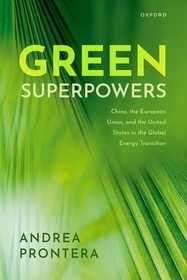
Green Superpowers
China, the European Union, and the United States in the Global Energy Transition
- Publisher's listprice GBP 105.00
-
47 407 Ft (45 150 Ft + 5% VAT)
The price is estimated because at the time of ordering we do not know what conversion rates will apply to HUF / product currency when the book arrives. In case HUF is weaker, the price increases slightly, in case HUF is stronger, the price goes lower slightly.
- Discount 10% (cc. 4 740 Ft off)
- Discounted price 42 667 Ft (40 635 Ft + 5% VAT)
Subcribe now and take benefit of a favourable price.
Subscribe
47 407 Ft

Availability
Estimated delivery time: In stock at the publisher, but not at Prospero's office. Delivery time approx. 3-5 weeks.
Not in stock at Prospero.
Why don't you give exact delivery time?
Delivery time is estimated on our previous experiences. We give estimations only, because we order from outside Hungary, and the delivery time mainly depends on how quickly the publisher supplies the book. Faster or slower deliveries both happen, but we do our best to supply as quickly as possible.
Product details:
- Publisher OUP Oxford
- Date of Publication 28 November 2024
- ISBN 9780198875284
- Binding Hardback
- No. of pages304 pages
- Size 240x160x25 mm
- Weight 630 g
- Language English 541
Categories
Short description:
Green Superpowers: China, the European Union, and the United States in the Global Energy Transition offers an in-depth comparative analysis of the green foreign energy policies and green power strategies of the three main international actors in this transformative process: China, the European Union, and the United States.
MoreLong description:
Fossil fuels have been key to major powers' foreign policies for a long time. In the context of the current global energy transition, renewables and low-carbon technologies are emerging as elements that can have a similarly important impact on twenty-first century world politics.
Green Superpowers: China, the European Union, and the United States in the Global Energy Transition offers an in-depth comparative analysis of the green foreign energy policies and green power strategies of the three main international actors in this transformative process: China, the European Union, and the United States. These green superpowers alone account for about half of global carbon dioxide emissions, which is the primary driver of climate change, and they are frontrunners in the global race for promoting and deploying renewables and innovative low-carbon technologies.
To analyse this changing landscape, Prontera combines insights from international political economy, comparative public policy, international relations, and energy policy scholarship. The book develops an original framework for mapping and studying the green foreign energy policies and green power strategies of major international actors and applies this framework to shed light on the recent efforts of China, the European Union, and the US. In doing so, it illustrates the links between the domestic green approaches that these green superpowers are promoting and their external actions regarding renewables and low-carbon technologies, whilst drawing attention to the limits and potential of green power strategies in the transition away from fossil fuels and the struggles to address a mounting climate crisis.
The book is an achievement that will benefit any scholar or policymaker comparing how green industrial policy is evolving in the three largest global actors.
Table of Contents:
List of Figures
List of Tables
Introduction
Green Foreign Energy Policy: A Framework for the Analysis
China: The Unexpected and Contested Green Giant
The European Union: The Would-Be Green Leader
The United States: A Reluctant Follower or a Re-emerging Leader?
China, the European Union, and the United States: A Comparative Perspective
Conclusions
References
Index

