

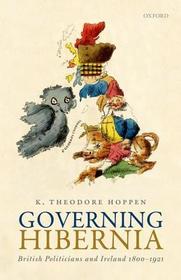
Governing Hibernia
British Politicians and Ireland 1800-1921
- Publisher's listprice GBP 61.00
-
27 541 Ft (26 230 Ft + 5% VAT)
The price is estimated because at the time of ordering we do not know what conversion rates will apply to HUF / product currency when the book arrives. In case HUF is weaker, the price increases slightly, in case HUF is stronger, the price goes lower slightly.
- Discount 10% (cc. 2 754 Ft off)
- Discounted price 24 787 Ft (23 607 Ft + 5% VAT)
Subcribe now and take benefit of a favourable price.
Subscribe
27 541 Ft

Availability
printed on demand
Why don't you give exact delivery time?
Delivery time is estimated on our previous experiences. We give estimations only, because we order from outside Hungary, and the delivery time mainly depends on how quickly the publisher supplies the book. Faster or slower deliveries both happen, but we do our best to supply as quickly as possible.
Product details:
- Publisher OUP Oxford
- Date of Publication 18 August 2016
- ISBN 9780198207436
- Binding Hardback
- No. of pages352 pages
- Size 239x166x23 mm
- Weight 650 g
- Language English 0
Categories
Short description:
The first book to examine in detail how British ministers and politicians sought to govern Ireland throughout the period of Anglo-Irish Union (1800-1921), this trenchant and original account argues that British politicians had little understanding or time for Irish matters, and oscillated between policies of coercion and assimilation.
MoreLong description:
The Anglo-Irish Union of 1800 which established the United Kingdom of Great Britain and Ireland made British ministers in London more directly responsible for Irish affairs than had previously been the case. The Act did not, however, provide for full integration, and left in existence a separate administration in Dublin under a Viceroy and a Chief Secretary. This created tensions that were never resolved. The relationship that ensued has generally been interpreted in terms of 'colonialism' or 'post-colonialism', concepts not without their problems in relation to a country so geographically close to Britain and, indeed, so closely connected constitutionally.
Governing Hibernia seeks to examine the Union relationship from a new and different perspective. In particular it argues that London's policies towards Ireland in the period between the Union and the Anglo-Irish Treaty of 1921 oscillated sharply. At times, the policies were based on a view of an Ireland so distant, different, and violent that (regardless of promises made in 1800) its government demanded peculiarly Hibernian policies of a coercive kind (c. 1800-1830); at others, they were based on the premise that stability was best achieved by a broadly assimilationist approach -- in effect attempting to make Ireland more like Britain (c. 1830-1868); and finally they made a return to policies of differentiation though in less coercive ways than had been the case in the decades immediately after the Union (c. 1868-1921). The outcome of this last policy of differentiation was a disposition, ultimately common to both of the main British political parties, to grant greater measures of devolution and ultimately independence, a development finally rendered viable by the implementation of Irish partition in 1921/2.
given our tendency to view the period as a struggle for independence, this fascinating book on the failure of the Union offers a useful change of perspective.
Table of Contents:
Introduction
PART I: A FARAWAY COUNTRY, c. 1800 - c. 1830
Bringing Ireland into the Fold: A Kind of Theory
Keeping Ireland at Arm's Length: A Kind of Reality
PART II: MENUS OF ASSIMILATION, c. 1830 - c. 1868
A Changing Climate
Direct and Scenic Routes
Poverty, Famine, Land
Ambiguous Outcomes
PART III: DANCING TO IRISH TUNES, c. 1868 - c. 1921
Back to the Future
Doing it on the Cheap: Liberals
Throwing Money About: Conservatives
Partition or Squaring (some) Circles
List of Manuscript Sources
Index

