

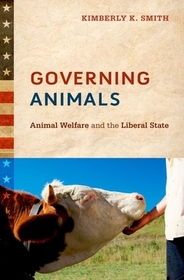
Governing Animals
Animal Welfare and the Liberal State
- Publisher's listprice GBP 49.99
-
22 570 Ft (21 495 Ft + 5% VAT)
The price is estimated because at the time of ordering we do not know what conversion rates will apply to HUF / product currency when the book arrives. In case HUF is weaker, the price increases slightly, in case HUF is stronger, the price goes lower slightly.
- Discount 10% (cc. 2 257 Ft off)
- Discounted price 20 313 Ft (19 346 Ft + 5% VAT)
Subcribe now and take benefit of a favourable price.
Subscribe
22 570 Ft

Availability
printed on demand
Why don't you give exact delivery time?
Delivery time is estimated on our previous experiences. We give estimations only, because we order from outside Hungary, and the delivery time mainly depends on how quickly the publisher supplies the book. Faster or slower deliveries both happen, but we do our best to supply as quickly as possible.
Product details:
- Publisher OUP USA
- Date of Publication 12 July 2012
- ISBN 9780199895755
- Binding Hardback
- No. of pages234 pages
- Size 163x239x22 mm
- Weight 454 g
- Language English 0
Categories
Short description:
Governing Animals explores the role of the liberal state in protecting animal welfare. Examining liberal concepts such as the social contract, property rights, and representation, Kimberly K. Smith argues that liberalism properly understood can recognize the moral status and social meaning of animals and provides guidance in fashioning animal policy.
MoreLong description:
What is the role of government in protecting animal welfare? What principles should policy makers draw on as they try to balance animal welfare against human liberty?
Much has been written in recent years on our moral duties towards animals, but scholars and activists alike have neglected the important question of how far the state may go to enforce those duties. Kimberly K. Smith fills that gap by exploring how liberal political principles apply to animal welfare policy. Focusing on animal welfare in the United States, Governing Animals begins with an account of the historical relationship between animals and the development of the American liberal welfare state. It then turns to the central theoretical argument: Some animals (most prominently pets and livestock) may be considered members of the liberal social contract. That conclusion justifies limited state intervention to defend their welfare - even when such intervention may harm human citizens. Taking the analysis further, the study examines whether citizens may enjoy property rights in animals, what those rights entail, how animals may be represented in our political and legal institutions, and what strategies for reform are most compatible with liberal principles. The book takes up several policy issues along the way, from public funding of animal rescue operations to the ethics of livestock production, animal sacrifice, and animal fighting.
Beyond even these specific policy questions, this book asks what sort of liberalism is suitable for the challenges of the twenty-first century. Smith argues that investigating the political morality of our treatment of animals gives us insight into how to design practices and institutions that protect the most vulnerable members of our society, thus making of our shared world a more fitting home for both humans and the nonhumans to which we are so deeply connected.
Governing Animals is a smart, readable entry in the growing literature on animals and politics making a political argument for animal welfare ... Highly recommended.
Table of Contents:
Preface
Introduction
Chapter One: Trials
Chapter Two: Contracts
Chapter Three: Property
Chapter Four: Representation
Chapter Five: Reform
Conclusion
Bibliography
Index

