

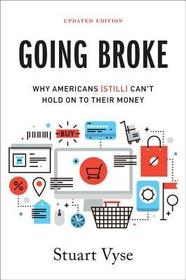
Going Broke
Why Americans (Still) Can't Hold On To Their Money
- Publisher's listprice GBP 19.49
-
8 799 Ft (8 380 Ft + 5% VAT)
The price is estimated because at the time of ordering we do not know what conversion rates will apply to HUF / product currency when the book arrives. In case HUF is weaker, the price increases slightly, in case HUF is stronger, the price goes lower slightly.
- Discount 10% (cc. 880 Ft off)
- Discounted price 7 919 Ft (7 542 Ft + 5% VAT)
Subcribe now and take benefit of a favourable price.
Subscribe
8 799 Ft

Availability
Estimated delivery time: In stock at the publisher, but not at Prospero's office. Delivery time approx. 3-5 weeks.
Not in stock at Prospero.
Why don't you give exact delivery time?
Delivery time is estimated on our previous experiences. We give estimations only, because we order from outside Hungary, and the delivery time mainly depends on how quickly the publisher supplies the book. Faster or slower deliveries both happen, but we do our best to supply as quickly as possible.
Product details:
- Edition number 2
- Publisher OUP USA
- Date of Publication 25 October 2018
- ISBN 9780190677848
- Binding Paperback
- No. of pages344 pages
- Size 155x234x20 mm
- Weight 408 g
- Language English 0
Categories
Short description:
First published in 2008, Stuart Vyse's Going Broke described the epidemic of personal debt that existed in the years leading up to the Great Recession, and anticipated the home mortgage crisis that started it. Ten years later, a fully-First published in 2008, Stuart Vyse's Going Broke described the epidemic of personal debt that existed in the years leading up to the Great Recession, and anticipated the home mortgage crisis that started it. Ten years later, a fully-updated new edition tackles the post-recession era of economic recovery
MoreLong description:
Over the last four decades, debt, bankruptcy, and home foreclosures have risen to epidemic levels, and the personal savings rate has sunk dangerously low. Why, in the richest nation on earth, can't Americans hold on to their money?
First published in 2008, Stuart Vyse's Going Broke described the epidemic of personal debt that existed in the years leading up to the Great Recession, and anticipated the home mortgage crisis that started it. Ten years later, a fully-updated new edition tackles the post-recession era of economic recovery. Today total household debt has actually surpassed pre-recession levels, and some of the same problems that preceded the crash are back again. But the shape of our troubles has changed: the new face of financial failure features auto repossession, bankruptcy, eviction, wage garnishment, and being sued for unpaid bills. Vyse offers a unique psychological perspective on the financial behavior of the many Americans today who find they cannot make ends meet, illuminating these and other causes of our wildly self-destructive spending habits. But he doesn't entirely blame the victim, arguing instead that that the mountain of debt burying so many of us is the inevitable byproduct of America's turbo-charged economy together with social and technological trends that undermine our self-control. This updated edition of Going Broke illuminates everything from the rise of the credit card, to ballooning student loan debt, to the expansion of new shopping opportunities provided by social media, revealing how vast changes in American society over the last 40 years have greatly complicated our relationship with money. Vyse concludes with both personal advice for the individual who wants to achieve greater financial stability and with pointed recommendations for economic and social change that will help promote the financial health of all Americans.
---With deep compassion and penetrating insight, Stuart Vyse turns the lens of science to uncover the reasons so many people cannot save what they earn--- Vyse's program on how to avoid debt should be printed on the back of every credit card application form.--- -Michael Shermer, author of Why People Believe Weird Things and The Mind of the Market
Table of Contents:
Acknowledgements
Foreword
Preface
Chapter 1: The Open Drain
Chapter 2: Making Sense of Financial Failure
Chapter 3: The Road to Ruin
Chapter 4: Self-Control and Money
Chapter 5: A Different Road to Ruin
Chapter 6: New Ways of Wanting
Chapter 7: New Ways of Spending
Chapter 8: Thinking About Money
Chapter 9: How Not to Go Broke
Notes
Resources
A Note About the Interviews
Index

