

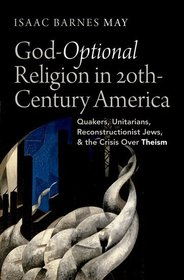
God-Optional Religion in Twentieth-Century America
Quakers, Unitarians, Reconstructionist Jews, and the Crisis Over Theism
- Publisher's listprice GBP 60.00
-
27 090 Ft (25 800 Ft + 5% VAT)
The price is estimated because at the time of ordering we do not know what conversion rates will apply to HUF / product currency when the book arrives. In case HUF is weaker, the price increases slightly, in case HUF is stronger, the price goes lower slightly.
- Discount 10% (cc. 2 709 Ft off)
- Discounted price 24 381 Ft (23 220 Ft + 5% VAT)
Subcribe now and take benefit of a favourable price.
Subscribe
27 090 Ft

Availability
printed on demand
Why don't you give exact delivery time?
Delivery time is estimated on our previous experiences. We give estimations only, because we order from outside Hungary, and the delivery time mainly depends on how quickly the publisher supplies the book. Faster or slower deliveries both happen, but we do our best to supply as quickly as possible.
Product details:
- Publisher OUP USA
- Date of Publication 13 February 2023
- ISBN 9780197624234
- Binding Hardback
- No. of pages342 pages
- Size 237x163x26 mm
- Weight 644 g
- Language English 262
Categories
Short description:
God-Optional Religion in Twentieth-Century America provides a historical account of the idea that being religious and believing in God might be separate concepts. Isaac Barnes May focuses on the story of three groups-liberal Quakers, Unitarians, and the forerunners of what would become Reconstructionist Judaism-and how they attempted to preserve their faith in the modern world by redefining what it meant to be religious.
MoreLong description:
By the beginning of the twentieth century, it had become harder for many Americans to believe in God. Religious groups struggled to adapt to rapidly changing cultural and scientific developments that seemed to challenge the plausibility of traditional beliefs. In God-Optional Religion in Twentieth-Century America, Isaac Barnes May focuses on the stories of three groups-liberal Quakers, Unitarians, and the forerunners of what would become Reconstructionist Judaism-that attempted to preserve their faith in the modern world by redefining what it meant to be religious. Between the 1920s and the 1960s, these communities underwent the most massive theological change imaginable, allowing their members the choice of what kind of God they wanted to believe in, or the option to not believe in God at all.
These groups pioneered the idea that being religious and believing in God might be separate concepts, a notion that spread widely, moving from church pulpits to novels and magazine covers. Eventually, the Supreme Court enshrined the idea that "God" could mean many different things in American law. God-Optional Religion in Twentieth-Century America provides an intellectual history that helps make sense of why most contemporary Americans' answer to whether they believe in God is often far more complicated than a simple "yes" or "no."
Isaac Barnes May skilfully weaves biography and history to show how a group of radical theological thinkers, confronted with religious doubt, found existential meaning and social hope, even at the boundaries of belief. May charts the despair that Christians and Jews in the early twentieth century felt at the loss of religious certainty, as well as the persistence and passion of their struggles to keep the faith, pointing toward a profound reconsideration of the sources of the self and social progress in an increasingly non-theistic America. This brilliant historical narrative speaks to the present era with an undeniable urgency.
Table of Contents:
Acknowledgements
Introduction
1. Putting Away Childish Things
2. Scientists and Mystics
3. Why Be a Jew?
4. Outgrowing the Past
5. The Boundary with Godless Religion
6. Fruits Not Roots
7. Legalizing God-Optional Religion
Epilogue

