

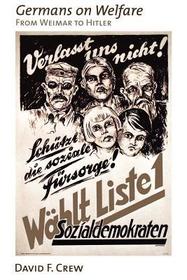
Germans on Welfare
From Weimar to Hitler
- Publisher's listprice GBP 67.00
-
30 250 Ft (28 810 Ft + 5% VAT)
The price is estimated because at the time of ordering we do not know what conversion rates will apply to HUF / product currency when the book arrives. In case HUF is weaker, the price increases slightly, in case HUF is stronger, the price goes lower slightly.
- Discount 10% (cc. 3 025 Ft off)
- Discounted price 27 225 Ft (25 929 Ft + 5% VAT)
Subcribe now and take benefit of a favourable price.
Subscribe
30 250 Ft

Availability
printed on demand
Why don't you give exact delivery time?
Delivery time is estimated on our previous experiences. We give estimations only, because we order from outside Hungary, and the delivery time mainly depends on how quickly the publisher supplies the book. Faster or slower deliveries both happen, but we do our best to supply as quickly as possible.
Product details:
- Publisher OUP USA
- Date of Publication 14 February 2002
- ISBN 9780195118780
- Binding Paperback
- No. of pages304 pages
- Size 155x235x18 mm
- Weight 413 g
- Language English 0
Categories
Short description:
Germans on Welfare is a comprehensive study of the welfare system in the Weimar Republic. Adopting a "history of everyday life" perspective, David Crew examines not only high-level policy and debate, but also ordinary Germans' daily experiences and encounters with the welfare state, upon which millions depended for their livelihood. Crew ultimately shows why the collapse of the welfare system, one of the pillars of the Weimar social republic, led so quickly to the Nazi racial state in the years after 1933.
MoreLong description:
The welfare state was one of the pillars of the Weimar Republic. The Weimar experiment in democracy depended to no small degree upon the welfare system's ability to give German citizens at least a fundamental level of material and mental security in the face of the new risks to which they had been exposed by the effects of the lost war, revolution, and inflation. But the problems of the postwar period meant that, even in its best years, the Weimar welfare state was dangerously overburdened. The onset of the Depression and the growth of mass unemployment after 1929 destroyed republican democracy and the welfare state upon which it was based. On the ruins of Weimars social republic, the Nazis built a murderous racial state.
Existing work on the Weimar welfare state concentrates largely on the discussions of social reformers, welfare experts, feminists, and the laws and institutions that their debates produced. Yet the Weimar welfare state was not simply the product of discourse and discursive struggles; it was also constructed and re-produced by the daily interactions of hard-pressed officials and impatient, often desperate clients. Adopting a "history of everyday life" perspective, Germans on Welfare: From Weimar to Hitler, 1919-1935 shows how welfare discourse and policy were translated into welfare practices by local officials and appropriated, contested, or re-negotiated by millions of welfare clients.
the latest and [one] of the most impressive contributions to the burgeoning field of the history of German social welfare.

