

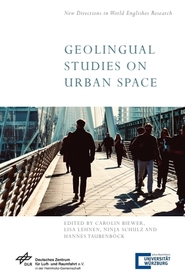
Geolingual Studies on Urban Space
Series: New Directions in World Englishes Research;
- Publisher's listprice GBP 125.00
-
56 437 Ft (53 750 Ft + 5% VAT)
The price is estimated because at the time of ordering we do not know what conversion rates will apply to HUF / product currency when the book arrives. In case HUF is weaker, the price increases slightly, in case HUF is stronger, the price goes lower slightly.
- Discount % (cc. 0 Ft off)
- Discounted price 0 Ft (0 Ft + 5% VAT)
Subcribe now and take benefit of a favourable price.
Subscribe
56 437 Ft

Availability
Not yet published.
Why don't you give exact delivery time?
Delivery time is estimated on our previous experiences. We give estimations only, because we order from outside Hungary, and the delivery time mainly depends on how quickly the publisher supplies the book. Faster or slower deliveries both happen, but we do our best to supply as quickly as possible.
Product details:
- Publisher Edinburgh University Press
- Date of Publication 31 August 2026
- ISBN 9781399556606
- Binding Hardback
- No. of pages448 pages
- Size 234x156 mm
- Language English
- Illustrations 17 colour illustrations, 69 B&W illustrations 700
Categories
Short description:
Combines linguistics, geography and computational humanities to integrate the complexities of urban spaces into world Englishes research.
MoreLong description:
Bringing together an interdisciplinary range of leading researchers, this book bridges gaps in urban research by combining methods from linguistics, geography and computational humanities and by exploring different data sets to understand the complexities of language behaviour in urban spaces. The equipment and arrangement of space situates where people live and work. It influences mobility, interactions, networks, identities and connectedness, reflected in and reinforced by language: Communities manifest themselves through the choice of language or linguistic variants in multilingual contexts. On the level of discourse, language reveals attitudes towards others as well as perceptions and evaluations of space. Geography can describe the physical space with remote sensing and GIS data. In computational humanities, language models are developed to perform topic modelling and sentiment analysis.
The book demonstrates how established methodologies from across disciplines combined with a broader perspective on established concepts and methodologies from world Englishes will advance and complement linguistic research in this field. Drawing on case studies from various megacities, densely populated city-states and capitals around the world including London, Edinburgh, New York, Tokyo, Singapore, Hong Kong, Davao City, Accra, and Mexico City, it provides important insights into multilingual urban spaces in terms of new methodological approaches and results.
Table of Contents:
List of Figures
List of Tables
Notes on Contributors
1. Geolingual Studies as a New Research Approach in World Englishes – an Introduction
Carolin Biewer, Hannes Taubenböck, Lisa Lehnen and Ninja Schulz
Part I – Sociolinguistic approaches to English in multilingual urban areas
2. Identity Conceptions, Linguistic Repertoires, and Language Attitudes and Use in Multilingual Singapore: Developments and Recent Changes
Jakob R. E. Leimgruber, Sarah Buschfeld and Peter Siemund
3. Ghanaian Language Attitudes towards Ghanaian Pidgin English and Ghanaian English
Lauryn Bediako Akuffo
4. English in Tokyo’s Public Space: Explorations from Ameyoko and Ueno Keisei Station
Patrick Heinrich
Part II – Place identity and cultural conceptualisations of (urban) spaces
5. Place Identities in Districts of Davao City and Hong Kong: Evaluating Places in Discourse
Sabine Heps, Lisa Lehnen and Carolin Biewer
6. Leisure Activities in Discourse: District Identity Formation in Mexico City through Discourse
Diana Lynn Diaz
7. Imagined communities on Social Media: Exploring Linguistic Othering during Brexit
Zuzanna Elliot and Richard Lemoine-Rodríguez
8. Regionalising the Pandemic – The Use of Spatial Metaphors and Toponyms Setting the Scene in the Early Days of COVID-19
Dominik Kremer, Tilo Felgenhauer and Andreas Wagner
Part III – Spatio-linguistic approaches to urban social media discourse
9. Using Geolocated Social Media Data to Verify the Socio-spatial Dimension of Cities – A Case Study on Tweets from New York
Richard Lemoine-Rodríguez, Carolin Biewer, Johannes Mast and Hannes Taubenböck
10. Exploring Twitter Discourse across Different Districts of Edinburgh during the COVID-19 Pandemic
Ninja Schulz and Richard Lemoine-Rodríguez
11. Using Geolocated Social Media Data for Understanding the Relationships between Language, Topic and Mobility: A Case Study on a Local Use of English in Nigeria
Johannes Mast, Dominik Heps and Marta Sapena Moll
12. Spatio-temporal and Linguistic Assessments of Urban Space: Applications, Implications and Outlook
Carolin Biewer, Lisa Lehnen, Richard Lemoine-Rodríguez, Ninja Schulz and Hannes Taubenböck,

