

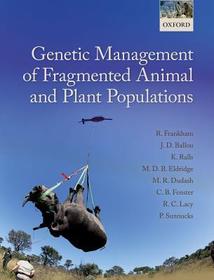
Genetic Management of Fragmented Animal and Plant Populations
- Publisher's listprice GBP 125.00
-
59 718 Ft (56 875 Ft + 5% VAT)
The price is estimated because at the time of ordering we do not know what conversion rates will apply to HUF / product currency when the book arrives. In case HUF is weaker, the price increases slightly, in case HUF is stronger, the price goes lower slightly.
- Discount 10% (cc. 5 972 Ft off)
- Discounted price 53 747 Ft (51 188 Ft + 5% VAT)
Subcribe now and take benefit of a favourable price.
Subscribe
59 718 Ft

Availability
printed on demand
Why don't you give exact delivery time?
Delivery time is estimated on our previous experiences. We give estimations only, because we order from outside Hungary, and the delivery time mainly depends on how quickly the publisher supplies the book. Faster or slower deliveries both happen, but we do our best to supply as quickly as possible.
Product details:
- Publisher OUP Oxford
- Date of Publication 13 July 2017
- ISBN 9780198783398
- Binding Hardback
- No. of pages432 pages
- Size 248x196x27 mm
- Weight 1096 g
- Language English
- Illustrations 168 black and white 0
Categories
Short description:
One of the greatest unmet issues in conservation biology is the genetic management of fragmented populations of numerous animal and plant species. Many populations are going extinct unnecessarily for genetic reasons so there is now urgent need for an authoritative textbook on the rational genetic management of fragmented populations.
MoreLong description:
One of the greatest unmet challenges in conservation biology is the genetic management of fragmented populations of threatened animal and plant species. More than a million small, isolated, population fragments of threatened species are likely suffering inbreeding depression and loss of evolutionary potential, resulting in elevated extinction risks. Although these effects can often be reversed by re-establishing gene flow between population fragments, managers very rarely do this. On the contrary, genetic methods are used mainly to document genetic differentiation among populations, with most studies concluding that genetically differentiated populations should be managed separately, thereby isolating them yet further and dooming many to eventual extinction! Many small population fragments are going extinct principally for genetic reasons. Although the rapidly advancing field of molecular genetics is continually providing new tools to measure the extent of population fragmentation and its genetic consequences, adequate guidance on how to use these data for effective conservation is still lacking.
This accessible, authoritative text is aimed at senior undergraduate and graduate students interested in conservation biology, conservation genetics, and wildlife management. It will also be of particular relevance to conservation practitioners and natural resource managers, as well as a broader academic audience of conservation biologists and evolutionary ecologists.
This is a book with a mission...the authors do a laudable job of translating conservation genetic concepts into concrete management recommendations, a translation that is often missing in wildlife management.
Table of Contents:
Introduction
Section 1: Genetic problems in small isolated populations
Evolutionary genetics of small populations
Inbreeding reduces reproductive fitness
Loss of genetic diversity reduces ability to adapt
Population fragmentation causes inadequate gene flow and increases extinction risk
Section 2: Rescue and risk
Genetic rescue by augmenting gene flow
Outbreeding depression is uncommon and predictable
Modified rescue and risk expectations for species with diverse mating systems and modes of inheritance
Section 3: Developing management decisions
Is the taxonomy appropriate? Delineating species for conservation purposes
Determining the number and location of genetically differentiated population fragments
Are there populations suffering genetic erosion that would benefit from augmented gene flow?
Managing gene flow among isolated population fragments. I. Limited information
Managing gene flow among isolated population fragments. II. Management based on kinship
Global climate change increases the need for genetic management
Take home messages

