

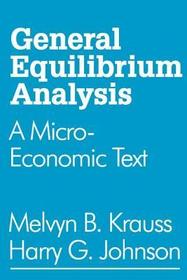
General Equilibrium Analysis
A Micro-Economic Text
-
GET 10% OFF
- Publisher's listprice GBP 50.99
-
24 360 Ft (23 200 Ft + 5% VAT)
The price is estimated because at the time of ordering we do not know what conversion rates will apply to HUF / product currency when the book arrives. In case HUF is weaker, the price increases slightly, in case HUF is stronger, the price goes lower slightly.
- Discount 10% (cc. 2 436 Ft off)
- Discounted price 21 924 Ft (20 880 Ft + 5% VAT)
21 924 Ft

Availability
Estimated delivery time: In stock at the publisher, but not at Prospero's office. Delivery time approx. 3-5 weeks.
Not in stock at Prospero.
Why don't you give exact delivery time?
Delivery time is estimated on our previous experiences. We give estimations only, because we order from outside Hungary, and the delivery time mainly depends on how quickly the publisher supplies the book. Faster or slower deliveries both happen, but we do our best to supply as quickly as possible.
Product details:
- Edition number 1
- Publisher Routledge
- Date of Publication 15 December 2006
- Number of Volumes Paperback
- ISBN 9780202308685
- Binding Paperback
- No. of pages344 pages
- Size 229x152 mm
- Weight 544 g
- Language English 0
Categories
Short description:
This is a new kind of textbook in microeconomic theory
MoreLong description:
This is a new kind of textbook in microeconomic theory. In place of the usual concentration on partial equilibrium analysis and discussion of a standard series of topics, the authors seek to introduce the student from the start to the general equilibrium approach to microeconomics, in the form of the two-sector model. This model is then applied to a variety of subjects in different special fields of economic analysis: welfare economics, international trade, public finance and income distribution. This book represents a very different approach to the teaching of micro-economic theory than normally followed, and one that will be of greater long-run value to the serious student of economics. In place of the usual textbook development of the subject as traditionally conceived through topics of increasing complexity and analytical difficulty, using partial equilibrium techniques of analysis, the book concentrates on the exposition and application of a more logically integrated set of tools that have been found of greater use in the analysis of problems arising not only in traditional micro-economics but also in a number of fields of economics that have customarily been hived off into separate specialized advanced courses. General Equilibrium Analysis starts with the description of the two-sector model and how these two sectors are built based on the individual micro-units in which they made up of and how they fit into the concept of the circular flow of income. Subsequent chapters deal with the evaluation of changes in factor endowment, demand preferences and technical progress by means of the model; and the theory of government, which includes both the theory of government expenditure, or public goods, and the theory of government tax and/or subsidy programmes-changes in budgetary scale, tax substitution and expenditure substitution. The model is then extended to an open economy-the so-called "two by two by two"--to consider both the normative effect of international trade and the possible determinants of international trade, with special attention being given to the relationship between commodity trade and factor mobility. Lastly this model is opened into a dynamic model of growth with its emphasis on requirements for the economy to maximize consumption per head on its long-run equilibrium growth path, and the effect of international trade on the growth path itself.
MoreTable of Contents:
1: Assumptions and Introductory Concepts; 2: Production, Distribution and General Equilibrium; 3: Exogenous Change in a Closed Economy; 4: Policy-Induced Change in a Closed Economy; 5: The Theory of Public Goods; 6: The Theory of International Trade; 7: The Theory of Tariffs; 8: The Theory of Distortions; 9: Exogenous Change in an Open Economy; 10: The Theory of Economic Growth
More
