

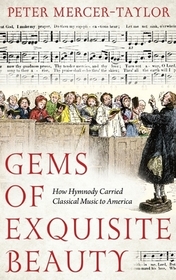
Gems of Exquisite Beauty
How Hymnody Carried Classical Music to America
- Publisher's listprice GBP 52.00
-
23 478 Ft (22 360 Ft + 5% VAT)
The price is estimated because at the time of ordering we do not know what conversion rates will apply to HUF / product currency when the book arrives. In case HUF is weaker, the price increases slightly, in case HUF is stronger, the price goes lower slightly.
- Discount 10% (cc. 2 348 Ft off)
- Discounted price 21 130 Ft (20 124 Ft + 5% VAT)
Subcribe now and take benefit of a favourable price.
Subscribe
23 478 Ft

Availability
printed on demand
Why don't you give exact delivery time?
Delivery time is estimated on our previous experiences. We give estimations only, because we order from outside Hungary, and the delivery time mainly depends on how quickly the publisher supplies the book. Faster or slower deliveries both happen, but we do our best to supply as quickly as possible.
Product details:
- Publisher OUP USA
- Date of Publication 10 December 2020
- ISBN 9780190842796
- Binding Hardback
- No. of pages398 pages
- Size 236x160x33 mm
- Weight 703 g
- Language English 44
Categories
Short description:
In the antebellum period, most Americans first encountered European classical music through hundreds of hymn tunes that tapped into classical melodies. This book is the first in-depth study of the rise and fall of these popular, but largely overlooked, adaptations and their place in nineteenth-century American musical life.
MoreLong description:
In the decades leading up to the Civil War, most Americans probably encountered European classical music primarily through hymn tunes. Hymnody was the most popular and commercially successful genre of the antebellum period in the United States, and the unquenchable thirst for new tunes to sing led to a phenomenon largely forgotten today: in their search for fresh material, editors lifted hundreds of tunes from the works of major classical composers to use as settings of psalms and hymns. The few that remain popular today — millions have sung "Joyful, Joyful We Adore Thee" to Beethoven and "Hark, The Herald Angels Sing" to Mendelssohn — are vestiges of one of the most distinctive trends in antebellum music-making.
Gems of Exquisite Beauty is the first in-depth study of the historical rise and fall of this adaptation practice, its artistic achievements, and its place in nineteenth-century American musical life. It traces the contributions of pioneering figures like Arthur Clifton and the impact of bestsellers like the Handel and Haydn Society Collection, which helped turn Lowell Mason into America's most influential musician. By telling the tales of these hymns and those who brought them into the world, author Peter Mercer-Taylor reveals a central part of the history of how the American public first came to meet and creatively engage with Europe's rich musical practices.
The text presents a lens into church hymnody that has been untapped by church music scholars in the past. This is a text to be read by students, directors, and those with a love and passion for hymnody.
Table of Contents:
Introduction
Chapter 1: Antebellum Psalmody in its Cultural Context
Chapter 2: An Immigrant's Musical Memoir: Clifton's 1819 Original Collection and the Modest Launch of a Tradition
Chapter 3: Institutional Certification: Mason's 1822 Handel and Haydn Society Collection and the First Wave
Chapter 4: Heyday: Kingsley's 1838 Sacred Choir and the Midcentury Mania
Chapter 5: Psalmodic Adaptation as Musical Translation
Epilogue
Appendix 1: Classical Music in Antebellum American Psalmody: The Repertoire
Appendix 2: The Repertoire by Composer
Notes
Works Cited
Index

