

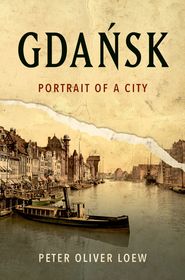
Gdańsk
Portrait of a City
- Publisher's listprice GBP 23.99
-
10 831 Ft (10 315 Ft + 5% VAT)
The price is estimated because at the time of ordering we do not know what conversion rates will apply to HUF / product currency when the book arrives. In case HUF is weaker, the price increases slightly, in case HUF is stronger, the price goes lower slightly.
- Discount 10% (cc. 1 083 Ft off)
- Discounted price 9 748 Ft (9 284 Ft + 5% VAT)
Subcribe now and take benefit of a favourable price.
Subscribe
10 831 Ft

Availability
Reprint in consideration
Why don't you give exact delivery time?
Delivery time is estimated on our previous experiences. We give estimations only, because we order from outside Hungary, and the delivery time mainly depends on how quickly the publisher supplies the book. Faster or slower deliveries both happen, but we do our best to supply as quickly as possible.
Product details:
- Publisher OUP USA
- Date of Publication 15 September 2024
- ISBN 9780197603864
- Binding Hardback
- No. of pages296 pages
- Size 244x165x30 mm
- Weight 590 g
- Language English
- Illustrations 36 black and white halftones 0
Categories
Short description:
The only single volume history in English, this acclaimed book tells the rich and fascinating story of Gdańsk, a unique city in both German and Polish history
MoreLong description:
It was where World War II began on September 1, 1939. Its wartime experience was immortalized in Günter Grass`s The Tin Drum. Later it attracted worldwide attention as the site where workers` strikes led by Lech Walesa and the ensuing Solidarity movement led to the fall of Communism in Eastern Europe. Proud Hanseatic port, heart of the Baltic Sea trade, twice a "Free City," present-day liberal, cosmopolitan center: Gdańsk's story between Germany and Poland is rich and fascinating.
As Peter Oliver Loew colorfully shows, Gdańsk, also known as Danzig, is incomparable not only because of its recent past but also in how it has so uniquely embodied the tensions of the European continent over the last millennium. Situated geographically and culturally within these tensions, the city has developed a fascinating identity amid frequent conflict and shifting national affiliations. From prehistoric amber workers to early Slavic dukes, the conquest of the Teutonic Order, and submission to the Polish crown, Gdańsk's development led to a remarkable flowering. Around 1650, no city between Moscow and Amsterdam was bigger or wealthier. As Poland's decline culminated with the Partitions of Poland, the city ultimately found itself annexed into Prussia. The destruction of 1945 brought an almost entirely new Polish population, who rebuilt the historic center, now part of the reconstituted Polish state. Through each historical rupture, and despite the efforts of distant courts and capitals to rewrite its history, Gdańsk has maintained--or sometimes rediscovered--a connection to its own past. Today the port city on the Vistula once again thrives, drawing strength from its diversity and history.
Drawing on the latest research of German and Polish historians, Peter Oliver Loew vividly portrays the politics, economy, society, culture, and everyday life of a European city par excellence.
This is the best portrait of Gdańsk ever written. Peter Oliver Loew vividly recounts the fascinating history of this Baltic town up to the present day. The reader gets a taste of what it meant to live there throughout centuries and can understand the unique position of the city located between Poland and Germany and claimed by both sides.
Table of Contents:
Translator's Note
Acknowledgments
Introduction: A Space of European Memory
1: Amber-Gold: Shedding Light on Prehistory
2: Green and Blue: Fishers, Merchants, Dukes, 997-1308
3: Brick-Red: Danzig as a Part of the Teutonic State, 1308-1454
4: Wheat-Gold and Rye-Brown: Danzig's Golden Age, 1454-1655
5: Fading Hues, 1655-1793
6: Prussian Blue: Fall and Rise in the Nineteenth Century, 1793-1918
7: Against a Red Background: From the Free City of Danzig to the Second World War, 1918-1945
8: Variations in White and Red: Gdańsk, “Fairer than Ever Before,” 1945-1980
9: Kaleidoscope: Into the Future with Solidarity and the Discovery of New Pasts
Epilogue: Why Gdańsk?
Appendix: Names of Places
Notes
Selected Bibliography
Index

