

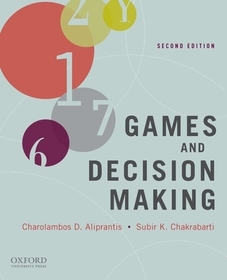
Games and Decision Making
- Publisher's listprice GBP 204.99
-
97 933 Ft (93 270 Ft + 5% VAT)
The price is estimated because at the time of ordering we do not know what conversion rates will apply to HUF / product currency when the book arrives. In case HUF is weaker, the price increases slightly, in case HUF is stronger, the price goes lower slightly.
- Discount 10% (cc. 9 793 Ft off)
- Discounted price 88 140 Ft (83 943 Ft + 5% VAT)
Subcribe now and take benefit of a favourable price.
Subscribe
97 933 Ft

Availability
Estimated delivery time: In stock at the publisher, but not at Prospero's office. Delivery time approx. 3-5 weeks.
Not in stock at Prospero.
Why don't you give exact delivery time?
Delivery time is estimated on our previous experiences. We give estimations only, because we order from outside Hungary, and the delivery time mainly depends on how quickly the publisher supplies the book. Faster or slower deliveries both happen, but we do our best to supply as quickly as possible.
Product details:
- Edition number 2
- Publisher OUP USA
- Date of Publication 22 March 2012
- ISBN 9780195300222
- Binding Hardback
- No. of pages480 pages
- Size 193x236x27 mm
- Weight 998 g
- Language English
- Illustrations 96 line illus. 0
Categories
Short description:
Games and Decision Making, Second Edition, is a unique blend of decision theory and game theory. From classical optimization to modern game theory, authors Charalambos D. Aliprantis and Subir K. Chakrabarti show the importance of mathematical knowledge in understanding and analyzing issues in decision making. Through an imaginative selection of topics, Aliprantis and Chakrabarti treat decision and game theory as part of one body of knowledge. They move from problems involving the individual decision-maker to progressively more complex problems such as sequential rationality, auctions, and bargaining. By building each chapter on material presented earlier, the authors offer a self-contained and comprehensive treatment of these topics.
MoreLong description:
Games and Decision Making, Second Edition, is a unique blend of decision theory and game theory. From classical optimization to modern game theory, authors Charalambos D. Aliprantis and Subir K. Chakrabarti show the importance of mathematical knowledge in understanding and analyzing issues in decision making. Through an imaginative selection of topics, Aliprantis and Chakrabarti treat decision and game theory as part of one body of knowledge. They move from problems involving the individual decision-maker to progressively more complex problems such as sequential rationality, auctions, and bargaining. By building each chapter on material presented earlier, the authors offer a self-contained and comprehensive treatment of these topics.
Successfully class-tested in an advanced undergraduate course at the Krannert School of Management and in a graduate course in economics at Indiana University, Games and Decision Making, Second Edition, is an essential text for advanced undergraduates and graduate students of decision theory and game theory. The book is accessible to students who have a good basic understanding of elementary calculus and probability theory.
New to this Edition
* Chapter 2 includes new sections on two-person games, best-response strategies, mixed strategies, and incomplete information
* Chapter 4 has been expanded to provide new material on behavior strategies and applications
* The chapter on auctions (5) includes a new section on revenue equivalence
* Offers two new chapters, on repeated games (7) and existence results (9)
* New applications have been added to all the chapters
Table of Contents:
Preface
Chapter 1. Choices
1.1. Functions
1.2. The optimization problem
1.3. First- and second-order conditions
1.4. Optimizing using the Lagrange method
1.5. Uncertainty and chance
1.6. Decision making under uncertainty
Chapter 2. Decisions and Games
2.1. Two-person matrix games
2.2. Strategic games
2.3. Dominant and dominated strategies
2.4. Solving matrix games with mixed strategies
2.5. Examples of two-person games
2.6. Best responses and Nash equilibria
2.7. Games with incomplete information
2.8. Applications
Chapter 3. Sequential Decisions
3.1. Graphs and trees
3.2. Single-person sequential decisions
3.3. Uncertainty and single-person decisions
Chapter 4. Sequential Games
4.1. The structure of sequential games
4.2. Equilibria in sequential games
4.3. Applications of sequential games
4.4. Solving sequential games with behavior strategies
Chapter 5. Auctions
5.1. Auctions with complete information
5.2. English auctions
5.3. Individual private-value auctions
5.4. Common-value auctions
5.5. Revenue equivalence
Chapter 6. Bargaining
6.1. The Nash solution
6.2. Monotonicity in bargaining
6.3. The core of a bargaining game
6.4. An allocation rule: the Shapley value
6.5. Two-person sequential bargaining
Chapter 7. Repeated Games
7.1. The structure and equilibria of repeated games
7.2. Subgame perfection in finite-horizon repeated games
7.3. Infinite-horizon repeated games
7.4. The Folk theorem and subgame perfect equilibrium
7.5. Applications of repeated and sequential games
Chapter 8. Sequential Rationality
8.1. The market for lemons
8.2. Beliefs and strategies
8.3. Consistency of beliefs
8.4. Expected payoff
8.5. Sequential equilibrium
8.6. Perfect Bayesian equilibrium
8.7. Signaling games
8.8. Applications
Chapter 9. Existence of Equilibria
9.1. Some Mathematical Preliminaries
9.2. Zero-sum games
9.3. Existence of equilibrium in strategic form games
9.4. Existence of equilibrium in sequential games
9.5. Existence of sequential equilibrium
Bibliography

