

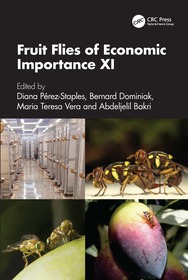
Fruit Flies of Economic Importance XI
- Publisher's listprice GBP 96.99
-
43 790 Ft (41 705 Ft + 5% VAT)
The price is estimated because at the time of ordering we do not know what conversion rates will apply to HUF / product currency when the book arrives. In case HUF is weaker, the price increases slightly, in case HUF is stronger, the price goes lower slightly.
- Discount 20% (cc. 8 758 Ft off)
- Discounted price 35 032 Ft (33 364 Ft + 5% VAT)
- Discount is valid until: 30 June 2026
Subcribe now and take benefit of a favourable price.
Subscribe
39 411 Ft

Availability
Estimated delivery time: In stock at the publisher, but not at Prospero's office. Delivery time approx. 3-5 weeks.
Not in stock at Prospero.
Why don't you give exact delivery time?
Delivery time is estimated on our previous experiences. We give estimations only, because we order from outside Hungary, and the delivery time mainly depends on how quickly the publisher supplies the book. Faster or slower deliveries both happen, but we do our best to supply as quickly as possible.
Product details:
- Edition number 1
- Publisher CRC Press
- Date of Publication 30 April 2026
- ISBN 9781041081975
- Binding Hardback
- No. of pages278 pages
- Size 246x174 mm
- Weight 670 g
- Language English
- Illustrations 84 Illustrations, black & white; 33 Halftones, black & white; 51 Line drawings, black & white; 32 Tables, black & white 700
Categories
Short description:
Fruit flies adversely impact the ability of the world’s nations to feed a growing world population. This book contains 19 contributions from many scientists which is intended to improve the ability of all nations to manage tephritids and to provide good quality food for their people.
MoreLong description:
Fruit flies (Diptera: Tephritidae) adversely impact the ability of the world’s nations to feed a growing world population. Hundreds of scientists work throughout many countries studying economically damaging fruit flies to improve our understanding of these pests and how to manage them. This book contains 19 contributions from many scientists, which is intended to improve the ability of all nations to manage tephritids and to provide good-quality food for their people.
This book starts with a reflection on the career and contribution of Prof. Antigone Zacharopoulou. It continues with three chapters expanding our knowledge and information on the biology, ecology, physiology, and behavior of tephritid flies. The following three chapters explore opportunities for international trade. Aspects of the Sterile Insect Technique (SIT) and natural enemies from different countries are explained in the next five chapters. Finally, the last seven chapters describe a diverse range of action programs and area-wide Integrated Pest Management (IPM).
Key features:
- Provides information on fruit fly diversity, courtship, and components involved in mating success.
- Offers opportunities to improve international trade on fruits susceptible to tephritids.
- Explores methods to optimize the components of the SIT and the use of parasitoids.
- Provides new insights into area-wide IPM and action programs.
- Includes contributions from relevant fruit-growing areas of the globe.
The Open Access version of this book, available at http://www.taylorfrancis.com, has been made available under a Creative Commons [Attribution-Non Commercial-No Derivatives (CC BY-NC-ND)] 4.0 license.
MoreTable of Contents:
1. In memoriam: Antigone Zacharopoulou; Section I Biology, ecology, physiology and behavior 2. Diversity and abundance of fruit flies (Diptera: Tephritidae) infesting cucurbit crops in the Morogoro region of Tanzania; 3. Assessment of courtship behavior and mating success in Ceratitis capitata (Diptera: Tephritidae): A comparison between laboratory-reared and wild flies; 4. Nice songs, good smells: Overexpression of antioxidants in transgenic male fruit flies blunts radiation-induced oxidative stress and improves sexual signaling; Section II Risk assessment, quarantine and post-harvest 5. Host reproduction number for fruit fly management and trade; 6. General guidelines to facilitate the opening of international markets for fruits and vegetables that are fruit fly hosts based on International Standards for Phytosanitary Measures; 7. Towards a systems approach for mitigating fruit fly risk in export fruit commodities from Africa; Section III Sterile insect technique 8. Status of the tephritid fruit fly production worldwide for the sterile insect technique application; 9. A focus on Morocco’s sterile insect technique initiative; 10. Packing and release methods for sterile fruit flies; 11. Production of a genetic sexing strain of Anastrepha fraterculus (DipteraTephritidae) for SIT programs in Brazil; Section IV Natural enemies and biological control 12. Abundance and diversity of tephritid parasitoids in different agroecological and climatic regions of Madagascar; Section V Area-wide IPM and action programs 13. Fifty-five years of a successful National Fruit Fly Program in Chile; 14. Current status of the National Fruit Fly Detection Programme in Chile; 15. National Fruit Fly Control and Eradication Program (Procem) in Argentina; 16. Eradicating Queensland fruit fly (Bactrocera tryoni) in Perth, Western Australia: History, challenges and future directions; 17. Area-wide fruit fly control with environmentally friendly techniques in Mauritius; 18. A tiered approach to the implementation of integrated fruit fly management programmes in the Americas; 19. Fruit flies and their monitoring in the Caribbean region
More
