

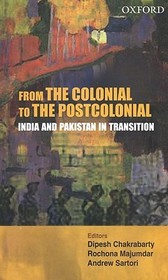
From the Colonial to the Postcolonial
India and Pakistan in Transition
- Publisher's listprice GBP 21.99
-
9 928 Ft (9 455 Ft + 5% VAT)
The price is estimated because at the time of ordering we do not know what conversion rates will apply to HUF / product currency when the book arrives. In case HUF is weaker, the price increases slightly, in case HUF is stronger, the price goes lower slightly.
- Discount 10% (cc. 993 Ft off)
- Discounted price 8 935 Ft (8 510 Ft + 5% VAT)
Subcribe now and take benefit of a favourable price.
Subscribe
9 928 Ft

Availability
Uncertain availability. Please turn to our customer service.
Why don't you give exact delivery time?
Delivery time is estimated on our previous experiences. We give estimations only, because we order from outside Hungary, and the delivery time mainly depends on how quickly the publisher supplies the book. Faster or slower deliveries both happen, but we do our best to supply as quickly as possible.
Product details:
- Publisher OUP India
- Date of Publication 22 March 2007
- ISBN 9780195679564
- Binding Hardback
- No. of pages381 pages
- Size 222x145x30 mm
- Weight 613 g
- Language English 0
Categories
Short description:
With particular focus on India and Pakistan, this volume discusses the social and political processes involved in the transition from the colonial order to postcolonial regimes. It looks at decolonization as a long-term process and highlights some of the historical complications involved in nations born under the aegis of the colonial rule evolving into postcolonial polities. The contributors include a range of distinguished scholars from North America, the United
Kingdom, South Asia, and Australia. They approach the issue of decolonization in different but mutually reinforcing ways, through constitutionalism, sports, housing, genders, minority issues, regionalism, and class formation.
Long description:
This volume addresses some of the key issues marking the process of decolonization in India and Pakistan. It looks at decolonization as a long-term process and highlights some of the historical complications involved in nations born under the aegis of the colonial rule evolving into postcolonial polities. The contributors include a range of distinguished scholars from North America, the United Kingdom, South Asia, and Australia. They approach the issue of
decolonization in different but mutually reinforcing ways, through constitutionalism, sports, housing, genders, minority issues, regionalism, and class formation.

