

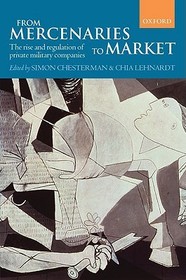
From Mercenaries to Market
The Rise and Regulation of Private Military Companies
- Publisher's listprice GBP 115.00
-
51 922 Ft (49 450 Ft + 5% VAT)
The price is estimated because at the time of ordering we do not know what conversion rates will apply to HUF / product currency when the book arrives. In case HUF is weaker, the price increases slightly, in case HUF is stronger, the price goes lower slightly.
- Discount 10% (cc. 5 192 Ft off)
- Discounted price 46 730 Ft (44 505 Ft + 5% VAT)
Subcribe now and take benefit of a favourable price.
Subscribe
51 922 Ft

Availability
printed on demand
Why don't you give exact delivery time?
Delivery time is estimated on our previous experiences. We give estimations only, because we order from outside Hungary, and the delivery time mainly depends on how quickly the publisher supplies the book. Faster or slower deliveries both happen, but we do our best to supply as quickly as possible.
Product details:
- Publisher OUP Oxford
- Date of Publication 12 July 2007
- ISBN 9780199228485
- Binding Hardback
- No. of pages310 pages
- Size 240x160x25 mm
- Weight 619 g
- Language English 0
Categories
Short description:
This book considers the growing importance of private military companies and efforts to regulate their activities. Private actors are thought by some to be mercenaries; others see them as the market's response to a security vacuum. This book looks at the use of potentially lethal force by non-state actors; how this has differed in situations such as Sierra Leone and Iraq; what rules currently constrain the behaviour of private military companies; and what forces shape the development of this new market.
MoreLong description:
Frequently characterized as either mercenaries in modern guise or the market's response to a security vacuum, private military companies are commercial firms offering military services ranging from combat and military training and advice to logistical support, and which play an increasingly important role in armed conflicts, UN peace operations, and providing security in unstable states.
Executive Outcomes turned around an orphaned conflict in Sierra Leone in the mid-1990s; Military Professional Resources Incorporated (MPRI) was instrumental in shifting the balance of power in the Balkans, enabling the Croatian military to defeat Serb forces and clear the way for the Dayton negotiations; in Iraq, estimates of the number of private contractors on the ground are in the tens of thousands. As they assume more responsibilities in conflict and post-conflict settings, their growing significance raises fundamental questions about their nature, their role in different regions and contexts, and their regulation.
This volume examines these issues with a focus on governance, in particular the interaction between regulation and market forces. It analyzes the current legal framework and the needs and possibilities for regulation in the years ahead. The book as a whole is organized around four sets of questions, which are reflected in the four parts of the book. First, why and how is regulation of PMCs now a challenging issue? Secondly, how have problems leading to a call for regulation manifested in different regions and contexts? Third, what regulatory norms and institutions currently exist and how effective are they? And, fourth, what role has the market to play in regulation?
As a resource, From Mercenaries to Market serves only as a starting point, but a very good one. At only 256 pages, and covering many different topics relating to PMCs, it is impressive that the contributors provide so much useful analysis and information. Every contribution is well cited, and chapters are complimented by a select bibliography that makes taking the next step easy for inquisitive readers
Table of Contents:
Foreword
Introduction
I Concerns
Morality and Regulation
What should and what should not be regulated?
II Challenges
Weak governments in search of strength: Africa's experience of mercenaries and private military companies
A government in search of cover: private military companies in Iraq
Transitional states in search of support: PMCs and security sector reform
III Norms
Private military companies under international humanitarian law
Private military companies and state responsibility
Domestic regulation: licensing regimes for the export of military goods and services
IV Markets
The emerging market for private military services and the problems of regulation
Make or buy? Principal-agent theory and the regulation of private military companies
Contract as a tool for regulating private military companies
Regulating the role of private military companies in shaping security and politics
The future of the market
Conclusion: From mercenaries to market
Bibliography
Index

