

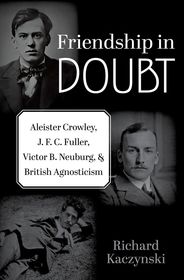
Friendship in Doubt
Aleister Crowley, J. F. C. Fuller, Victor B. Neuburg, and British Agnosticism
Series: Oxford Studies in Western Esotericism;
- Publisher's listprice GBP 82.00
-
37 023 Ft (35 260 Ft + 5% VAT)
The price is estimated because at the time of ordering we do not know what conversion rates will apply to HUF / product currency when the book arrives. In case HUF is weaker, the price increases slightly, in case HUF is stronger, the price goes lower slightly.
- Discount 10% (cc. 3 702 Ft off)
- Discounted price 33 321 Ft (31 734 Ft + 5% VAT)
Subcribe now and take benefit of a favourable price.
Subscribe
37 023 Ft

Availability
Estimated delivery time: In stock at the publisher, but not at Prospero's office. Delivery time approx. 3-5 weeks.
Not in stock at Prospero.
Why don't you give exact delivery time?
Delivery time is estimated on our previous experiences. We give estimations only, because we order from outside Hungary, and the delivery time mainly depends on how quickly the publisher supplies the book. Faster or slower deliveries both happen, but we do our best to supply as quickly as possible.
Product details:
- Publisher OUP USA
- Date of Publication 23 September 2024
- ISBN 9780197694008
- Binding Hardback
- No. of pages496 pages
- Size 229x145x38 mm
- Weight 816 g
- Language English 540
Categories
Short description:
Rebelling against Victorian religious and social strictures, occultist Aleister Crowley, soldier J. F. C. Fuller, and poet Victor Neuburg were active contributors and participants in the British secularist movement at the dawn of the twentieth century. Friendship in Doubt examines how the Agnostic movement inspired and introduced them to each other as foundational figures in the new religious movement of Thelema.
MoreLong description:
Infidel. Atheist. Rationalist. Agnostic. Occultist Aleister Crowley, soldier J. F. C. Fuller, and poet Victor Neuburg embraced these labels as active contributors and participants in the British secularist movement at the dawn of the twentieth century. Rebelling against Victorian religious and social strictures, they dreamed of a world guided by scientific evidence instead of superstition. Friendship in Doubt examines how the Agnostic movement-from Saladin's Agnostic Journal and G. W. Foote's Freethinker, to the Rationalist Press Association and its Literary Guide--inspired and introduced Crowley, Fuller, and Neuburg to each other as foundational figures in the new religious movement of Thelema. Agnosticism would inform not only Thelema, but also Crowley's publishing company S.P.R.T.; A���A���, a successor to the fragmented Hermetic Order of the Golden Dawn; the Equinox journal; and the concept of "magick" as Scientific Illuminism.
This volume also collects for the first time the contributions of all three to the Agnostic literature. This scarce and largely unknown material provides insight into the thinking of Crowley, Fuller and Neuburg at the start of their careers, and an understanding of their subsequent trajectories after they parted ways. As such, it provides unique insights into the role of Agnosticism in the formative years of an emerging occult movement which would go on to exert an immense influence on Western esotericism in the twentieth and twenty-first centuries.
Friendship in Doubt study makes a strong argument for the often-overlooked influence that agnosticism exerted on some currents of Western esotericism. Kaczynski has already established himself as an accomplished biographer with his Perdurabo: The Life of Aleister Crowley and is now proving himself equally adept in the field of intellectual biography.
Table of Contents:
CHAPTER ONE: THE AGNOSTICS
CHAPTER TWO: CROWLEY AND RATIONALISM
CHAPTER THREE: THE PRIZE
CHAPTER FOUR: AGNOSTICS ON CAMPUS
CHAPTER FIVE: BORROWED INFLUENCES
CHAPTER SIX: CROWLEY VS. THE RATIONALIST PRESS ASSOCIATION
CHAPTER SEVEN: FULLER & NEUBURG AFTER THE AGNOSTIC JOURNAL
CHAPTER EIGHT: LIFE AFTER CROWLEY
Conclusion
Acknowledgements
ANTHOLOGY OF PRIMARY TEXTS BY ALEISTER CROWLEY, J. F. C. FULLER, AND VICTOR NEUBURG

