

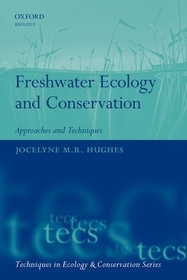
Freshwater Ecology and Conservation
Approaches and Techniques
Series: Techniques in Ecology & Conservation;
- Publisher's listprice GBP 62.00
-
27 993 Ft (26 660 Ft + 5% VAT)
The price is estimated because at the time of ordering we do not know what conversion rates will apply to HUF / product currency when the book arrives. In case HUF is weaker, the price increases slightly, in case HUF is stronger, the price goes lower slightly.
- Discount 10% (cc. 2 799 Ft off)
- Discounted price 25 194 Ft (23 994 Ft + 5% VAT)
Subcribe now and take benefit of a favourable price.
Subscribe
27 993 Ft

Availability
Estimated delivery time: In stock at the publisher, but not at Prospero's office. Delivery time approx. 3-5 weeks.
Not in stock at Prospero.
Why don't you give exact delivery time?
Delivery time is estimated on our previous experiences. We give estimations only, because we order from outside Hungary, and the delivery time mainly depends on how quickly the publisher supplies the book. Faster or slower deliveries both happen, but we do our best to supply as quickly as possible.
Product details:
- Publisher OUP Oxford
- Date of Publication 20 December 2018
- ISBN 9780198766421
- Binding Paperback
- No. of pages464 pages
- Size 235x156x21 mm
- Weight 790 g
- Language English
- Illustrations Over 50 illustrations 40
Categories
Short description:
Provides a single, comprehensive synthesis of the vast amount of techniques-related literature for freshwater ecology and conservation.
MoreLong description:
This practical manual of freshwater ecology and conservation provides a state-of-the-art review of the approaches and techniques used to measure, monitor, and conserve freshwater ecosystems. It offers a single, comprehensive, and accessible synthesis of the vast amount of literature for freshwater ecology and conservation that is currently dispersed in manuals, toolkits, journals, handbooks, 'grey' literature, and websites. Successful conservation outcomes are ultimately built on a sound ecological framework in which every species must be assessed and understood at the individual, community, catchment and landscape level of interaction. For example, freshwater ecologists need to understand hydrochemical storages and fluxes, the physical systems influencing freshwaters at the catchment and landscape scale, and the spatial and temporal processes that maintain species assemblages and their dynamics. A thorough understanding of all these varied processes, and the techniques for studying them, is essential for the effective conservation and management of freshwater ecosystems.
With its mostly classical structure - and its emphasis on methodological overviews of specific disciplines or taxonomic groups - the book will suit those early in their freshwater career
Table of Contents:
Part I
Overall considerations
Diversity of freshwater ecosystems and global distributions
Approaches to freshwater ecology and conservation
Sampling strategies and protocols for freshwater ecology and conservation
Part II
Measuring the component parts
Water quantity and hydrology
Chemical determinands of freshwater ecosystem functioning
Physical variables in freshwater ecosystems
Microorganisms 1: Phytoplankton, attached algae, and biofilms
Microorganisms 2: Viruses, prokaryotes, fungi, protozoans, and microscopic metazoans
Wetland plants and aquatic macrophytes
Freshwater vertebrates: An overview of survey design and key methodological considerations
Aquatic macroinvertebrates
Part III
Ecosystem dynamics, conservation, and management
Freshwater populations, interactions, and networks
Changes over time
Secondary data: Taking advantage of existing data and improving data availability for supporting freshwater ecology research and biodiversity conservation
Freshwater ecosystem services and functions
Invasive aquatic species
Freshwater ecosystem security and climate change
Restoration of freshwaters: Principles and practice
Wetland landscapes and catchment management

