

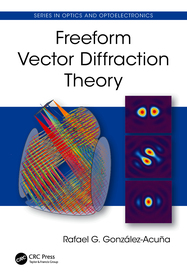
Freeform Vector Diffraction Theory
Series: Series in Optics and Optoelectronics;
-
GET 10% OFF
- Publisher's listprice GBP 124.99
-
56 432 Ft (53 745 Ft + 5% VAT)
The price is estimated because at the time of ordering we do not know what conversion rates will apply to HUF / product currency when the book arrives. In case HUF is weaker, the price increases slightly, in case HUF is stronger, the price goes lower slightly.
- Discount 10% (cc. 5 643 Ft off)
- Discounted price 50 789 Ft (48 371 Ft + 5% VAT)
50 789 Ft

Availability
Not yet published.
Why don't you give exact delivery time?
Delivery time is estimated on our previous experiences. We give estimations only, because we order from outside Hungary, and the delivery time mainly depends on how quickly the publisher supplies the book. Faster or slower deliveries both happen, but we do our best to supply as quickly as possible.
Product details:
- Edition number 1
- Publisher CRC Press
- Date of Publication 2 October 2026
- ISBN 9781041201984
- Binding Hardback
- No. of pages302 pages
- Size 234x156 mm
- Language English
- Illustrations 108 Illustrations, black & white; 108 Line drawings, black & white; 5 Tables, black & white 700
Categories
Short description:
Readers will gain a unified theoretical perspective that enables accurate prediction of electromagnetic field behavior in high-numerical-aperture systems and modern non-conventional optics.
MoreLong description:
Freeform Vector Diffraction Theory traces the conceptual journey from classical scalar diffraction to a rigorous and generalized framework for computing the vector diffraction patterns of arbitrary freeform wavefronts and complex, spatially varying polarization states.
Readers will gain a unified theoretical perspective that enables accurate prediction of electromagnetic field behavior in high-numerical-aperture systems and modern non-conventional optics. The book delivers these fundamental insights through detailed mathematical and geometrical toolkits, including vector calculus and Zernike polynomials, which facilitate rigorous derivations of the generalized Richards-Wolf integrals in both cylindrical and Cartesian coordinates. It also explores key practical applications in fields such as super-resolution microscopy, advanced lithography, and optical trapping. Through in-depth analysis of apodization functions and the response of radially, azimuthally, and linearly polarized light, readers will learn to precisely characterize complex optical systems affected by significant aberrations.
This work is an indispensable resource for leading researchers, optical design engineers, and graduate students in optics and photonics who seek to accurately model non-stigmatic and aberrated systems. The text clearly sets itself apart from other treatises on the subject by moving beyond the classical assumptions of spherical and ideal wavefronts typical of traditional theories. Instead, it offers a robust analytical framework for freeform surfaces and complex vectorial beams encountered in today’s technology. By masterfully integrating concepts such as the Malus-Dupin theorem and the angular spectrum representation, the book equips professionals with the essential tools to analyze the vector nature of light and optimize optical instruments in an era where structured light continues to reveal profound new insights into the electromagnetic nature of radiation.
More
Table of Contents:
1. Mathematical toolkit. 2. Geometrical optics toolkit. 3. Fundamentals Scalar diffraction theory. 4. Stigmatic vector diffraction theory: Richards-Wolfs Integrals. 5. The apodization function on the Richards-Wolf equations. 6. Stigmatic lenses and stigmatic vector diffraction. 7.Generalization of the Richards-Wolf equations to freeform
wavefronts. 8. Vector diffraction of aspherical wavefronts. 9. Diffraction in off-axis freeform vector optical systems.

