

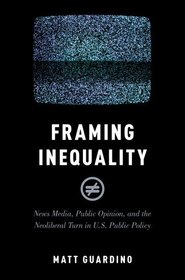
Framing Inequality
News Media, Public Opinion, and the Neoliberal Turn in U.S. Public Policy
Series: Studies in Postwar American Political Development;
- Publisher's listprice GBP 100.00
-
45 150 Ft (43 000 Ft + 5% VAT)
The price is estimated because at the time of ordering we do not know what conversion rates will apply to HUF / product currency when the book arrives. In case HUF is weaker, the price increases slightly, in case HUF is stronger, the price goes lower slightly.
- Discount 10% (cc. 4 515 Ft off)
- Discounted price 40 635 Ft (38 700 Ft + 5% VAT)
Subcribe now and take benefit of a favourable price.
Subscribe
45 150 Ft

Availability
printed on demand
Why don't you give exact delivery time?
Delivery time is estimated on our previous experiences. We give estimations only, because we order from outside Hungary, and the delivery time mainly depends on how quickly the publisher supplies the book. Faster or slower deliveries both happen, but we do our best to supply as quickly as possible.
Product details:
- Publisher OUP USA
- Date of Publication 14 March 2019
- ISBN 9780190888183
- Binding Hardback
- No. of pages324 pages
- Size 157x239x27 mm
- Weight 562 g
- Language English
- Illustrations 35 line drawings 0
Categories
Short description:
This book argues that political-economic features of the U.S. commercial media system have generated news coverage that favors neoliberal viewpoints during pivotal domestic policy debates since the early 1980s. It also demonstrates that this coverage can shape public opinion to support policies that exacerbate economic and political inequality.
MoreLong description:
Neoliberal policy approaches have swept over the American political economy in recent decades. In Framing Inequality, Matt Guardino focuses on the power of corporate news media in shaping how the public understands the pivotal policy debates of this period. Drawing on a wide range of empirical evidence from the dawn of the Reagan era into the Trump administration, he explains how profit pressures and commercial imperatives in the media have narrowed and trivialized news coverage and influenced public attitudes in the process. Guardino highlights how the political-economic structure of mainstream media operates to magnify some political messages and to mute or shut out others. He contends that news framing of policies that contribute to economic inequality has been unequal, and that this has undermined Americans' opportunities to express their views on an equal basis. Framing Inequality is a unique study that offers critical understanding of not only how neoliberalism succeeded as a political project, but also how Americans might begin to build a more democratic and egalitarian media system.
Who's to blame for America's intense partisanship? A favorite villain are the media and their unrelenting political agendas and ideological convictions. Not so says Matt Guardino. The media's commercial interests and support for private markets and business are the driving force of press coverage. Framing Inequality provocatively recasts debates about American democracy, economic inequality, and the press
Table of Contents:
Acknowledgements
Chapter 1 - Introduction
Chapter 2 - Toward a Critical Understanding of News Media, Public Opinion, and the Politics of Economic Inequality
Chapter 3 - "Gipper Sweeps Congress:" Commercial News Media and the Launch of the Reagan Revolution
Chapter 4 - "No One Wants to Change the System as Much as Those Who Are Trapped by the System:" Commercial News Media and the End of Welfare As We Knew It
Chapter 5 - Framing Inequality at the Ground Level: An Experiment
Chapter 6 - What's New? Media, Public Opinion, and Democracy in the 21st Century
Chapter 7 - Looking Backward, Looking Forward: Media, Power, and Inequality
Appendix A - Content Analysis Information for Chapters 3 - 6
Appendix B1 - Study Design Information for Chapter 5
Appendix B2 - Supplementary Analyses for Chapter 5
References

