

- Publisher's listprice GBP 76.00
-
34 314 Ft (32 680 Ft + 5% VAT)
The price is estimated because at the time of ordering we do not know what conversion rates will apply to HUF / product currency when the book arrives. In case HUF is weaker, the price increases slightly, in case HUF is stronger, the price goes lower slightly.
- Discount 10% (cc. 3 431 Ft off)
- Discounted price 30 883 Ft (29 412 Ft + 5% VAT)
Subcribe now and take benefit of a favourable price.
Subscribe
34 314 Ft

Availability
printed on demand
Why don't you give exact delivery time?
Delivery time is estimated on our previous experiences. We give estimations only, because we order from outside Hungary, and the delivery time mainly depends on how quickly the publisher supplies the book. Faster or slower deliveries both happen, but we do our best to supply as quickly as possible.
Product details:
- Publisher OUP Oxford
- Date of Publication 19 September 1991
- ISBN 9780198533917
- Binding Hardback
- No. of pages300 pages
- Size 242x161x24 mm
- Weight 659 g
- Language English 0
Categories
Short description:
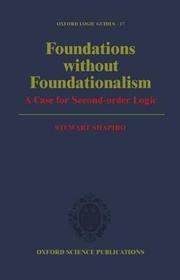
The central contention of this book is that second-order logic has a central role to play in laying the foundations of mathematics. In order to develop the argument fully, the author presents a detailed development of higher-order logic, including a comprehensive discussion of its semantics.
Professor Shapiro demonstrates the prevalence of second-order notions in mathematics, and also the extent to which mathematical concepts can be formulated in second-order languages. He shows how first-order languages are insufficient to codify many concepts in contemporary mathematics, and thus that higher-order logic is needed to fully reflect current mathematics.
Throughout, the emphasis is on discussing the philosophical and historical issues associated with this subject, and the implications that they have for foundational studies.
Long description:
The central contention of this book is that second-order logic has a central role to play in laying the foundations of mathematics. In order to develop the argument fully, the author presents a detailed development of higher-order logic, including a comprehensive discussion of its semantics.
Professor Shapiro demonstrates the prevalence of second-order notions in mathematics is practised, and also the extent to which mathematical concepts can be formulated in second-order languages . He shows how first-order languages are insufficient to codify many concepts in contemporary mathematics, and thus that higher-order logic is needed to fully reflect current mathematics.
Throughout, the emphasis is on discussing the philosophical and historical issues associated with this subject, and the implications that they have for foundational studies. For the most part, the author assumes little more than a familiarity with logic as might be gained from a beginning graduate course which includes the incompleteness of arithmetic and the Lowenheim-Skolem theorems. All those concerned with the foundations of mathematics will find this a thought-provoking discussion of some of the central issues in this subject.
'In this excellent treatise Shapiro defends the use of second-order languages and logic as framework for mathematics. His coverage of the wide range of logical and philosophical topics required for understanding the controversy over second-order logic is thorough, clear, and persuasive. Shapiro recognizes that it is unlikely that he has had the last word on these controversial philosophical subjects. Nevertheless, his book is certainly an excellent place to start work on them.'
Michael D. Resnik, University of North Carolina, History and Philosophy of Logic, 14 (1993)
Table of Contents:
PART I: ORIENTATION; Terms and questions; Foundationalism and foundations of mathematics; PART II: LOGIC AND MATHEMATICS; Theory; Metatheory; Second-order logic and mathematics; Advanced metatheory; PART III: HISTORY AND PHILOSOPHY; The historical triumph of first-order languages; Second-order logic and rule-following; The competition; Index.
More
