

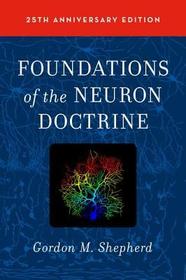
Foundations of the Neuron Doctrine
25th Anniversary Edition
- Publisher's listprice GBP 88.00
-
39 732 Ft (37 840 Ft + 5% VAT)
The price is estimated because at the time of ordering we do not know what conversion rates will apply to HUF / product currency when the book arrives. In case HUF is weaker, the price increases slightly, in case HUF is stronger, the price goes lower slightly.
- Discount 10% (cc. 3 973 Ft off)
- Discounted price 35 759 Ft (34 056 Ft + 5% VAT)
Subcribe now and take benefit of a favourable price.
Subscribe
39 732 Ft

Availability
printed on demand
Why don't you give exact delivery time?
Delivery time is estimated on our previous experiences. We give estimations only, because we order from outside Hungary, and the delivery time mainly depends on how quickly the publisher supplies the book. Faster or slower deliveries both happen, but we do our best to supply as quickly as possible.
Product details:
- Edition number 2
- Publisher OUP USA
- Date of Publication 17 December 2015
- ISBN 9780190259389
- Binding Hardback
- No. of pages384 pages
- Size 163x236x27 mm
- Weight 782 g
- Language English 0
Categories
Short description:
The neuron doctrine, first formulated in 1891, states that the brain is constructed of individual neurons, organized into functioning circuits that mediate behavior. Above all else, this is the main concept that underlies all of modern neuroscience. This 25th Aniversary Edition of The Foundations of the Neuron Doctrine explains how this theory was the product of an explosion of histological studies and vigorous debates near the end of the nineteenth century by an extraordinary group of scientists, most importantly the leading figure of the time, Santiago Ramon y Cajal of Spain, and includes the foremost nervous system investigators of many countries, such as Albrecht Kolliker, Sigmund Freud, Wilhelm His, August Forel, Fritdjof Nansen and Gustav Retzius.
MoreLong description:
The neuron doctrine, first formulated in 1891, states that the brain is constructed of individual neurons, organized into functioning circuits that mediate behavior. Above all else, this is the main concept that underlies all of modern neuroscience. This 25th Aniversary Edition of The Foundations of the Neuron Doctrine explains how this theory was the product of an explosion of histological studies and vigorous debates near the end of the nineteenth century by an extraordinary group of scientists, most importantly the leading figure of the time, Santiago Ramon y Cajal of Spain, and includes the foremost nervous system investigators of many countries, such as Albrecht Kolliker, Sigmund Freud, Wilhelm His, August Forel, Fritdjof Nansen and Gustav Retzius. The neuron doctrine explains how these eminent scientists used a selective nerve cell stain invented by Camillo Golgi of Italy and followed him in describing the fabulous branching patterns of nerve cells, providing strong evidence that the cells interact as individual units to form circuits. This work also describes how this view was opposed by Golgi, who maintained that the nerve cells form syncytial networks. Studies in the 1950s appeared resoundingly to confirm the nerve cell as an individual unit, as embodied in the neuron doctrine, which became the basis for the rise of concepts of normal and disordered neural function in the remaining 20th century. This 25th Anniversary Edition concludes by discussing how recent studies are showing a much greater degree of complexity in neuronal organization, so that the debate of neuron versus network is again coming to the fore of neuroscience research. Unique to this anniversary edition is the inclusion of commentaries by distinguished leaders in the neurosciences on the continuing relevance of the neuron doctrine for modern studies of the brain at all levels, from genes and molecules to microcircuits, neural networks, and behavior.
MoreTable of Contents:
Preface
Commentaries on The Neuron Doctrine
Cajal, Golgi and Ariadne's Needle - Marina Bentivoglio
Reflections on the Neuron Doctrine - Javier DeFelipe
The Neuron Doctrine Revisited: A Personal Account - Sten Grillner
Camillo Golgi, Foundations of the Neuron Doctrine, and the
History of Neurosciences - Paolo Mazzarello
Some Reflections on the Neuron Doctrine - Larry Swanson
1. Introduction
2. From the Beginnings to the Cell Theory
3. Do Nerve Cells Belong in the Cell Theory?
4. Nerve Cells or Nerve Nets?
5. Kolliker Gives In
6. Support Builds for Network
7. The Nerve Cell Studies of Freud
8. The Revolutionary Method of Golgi
9. A Neuron Theory Begins to Take Form: His, Forel, Nansen
10. Ramón y Cajal: The Shock of Recognition
11. The Early Discoveries of Cajal
12. The Laws of Cajal
13. Joining the Mainstream
14. The Neuron Doctrine
15. The Law of Dynamic Polarization
16. Controversy
17. The Synapse and the Growth Cone
18. Forging a Consensus
19. Confrontation in Stockholm
20. Modern Revisions of the Neuron Doctrine
Comment on Sources
References
Index

