

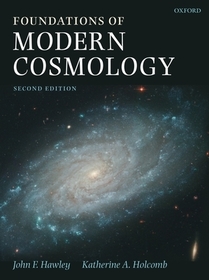
Foundations of Modern Cosmology
- Publisher's listprice GBP 105.00
-
47 407 Ft (45 150 Ft + 5% VAT)
The price is estimated because at the time of ordering we do not know what conversion rates will apply to HUF / product currency when the book arrives. In case HUF is weaker, the price increases slightly, in case HUF is stronger, the price goes lower slightly.
- Discount 10% (cc. 4 740 Ft off)
- Discounted price 42 667 Ft (40 635 Ft + 5% VAT)
Subcribe now and take benefit of a favourable price.
Subscribe
47 407 Ft

Availability
printed on demand
Why don't you give exact delivery time?
Delivery time is estimated on our previous experiences. We give estimations only, because we order from outside Hungary, and the delivery time mainly depends on how quickly the publisher supplies the book. Faster or slower deliveries both happen, but we do our best to supply as quickly as possible.
Product details:
- Edition number 2
- Publisher OUP Oxford
- Date of Publication 7 July 2005
- ISBN 9780198530961
- Binding Hardback
- No. of pages568 pages
- Size 254x196x33 mm
- Weight 1394 g
- Language English
- Illustrations numerous line drawings. halftones and mathematical examples 0
Categories
Short description:
Recent discoveries in astronomy have revolutionized the field of cosmology. While many long-standing questions in cosmology have now been answered, the new data pose new mysteries such as the nature of the "dark energy" that dominates the universe. This second edition provides an accessible and thorough text on the physics of cosmology and a lively account of the modern concordance model of the universe, from the big bang to a distant future dominated by dark energy.
MoreLong description:
Recent discoveries in astronomy, especially those made with data collected by satellites such as the Hubble Space Telescope and the Wilkinson Microwave Anisotropy Probe, have revolutionized the science of cosmology. These new observations offer the possibility that some long-standing mysteries in cosmology might be answered, including such fundamental questions as the ultimate fate of the universe.
Foundations of modern cosmology provides an accessible, thorough and descriptive introduction to the physical basis for modern cosmological theory, from the big bang to a distant future dominated by dark energy. This second edition includes the latest observational results and provides the detailed background material necessary to understand their implications, with a focus on the specific model supported by these observations, the concordance model. Consistent with the book's title, emphasis is given to the scientific framework for cosmology, particularly the basics concepts of physics that underlie modern theories of relativity and cosmology; the importance of data and observations is stressed throughout. The book sketches the historical background of cosmology, and provides a review of the relevant basic physics and astronomy. After this introduction, both special and general relativity are treated, before proceeding to an in-depth discussion of the big bang theory and physics of the early universe. The book includes current research areas, including dark matter and structure formation, dark energy, the inflationary universe, and quantum cosmology. The authors' website (http://www.astro.virginia.edu/~jh8h/Foundations) offers a wealth of supplemental information, including questions and answers, references to other sources, and updates on the latest discoveries.
Review from previous edition "Foundations of Modern Cosmology" by John F. Hawley and Katherine A. Holcomb is a welcome addition to the list of college-level astronomy textbooks for nonscience majors. [...] Hawley and Holcomb bring to their writing valuable first-hand knowledge and accomplishment in relativistic astrophysics research. Their book reflects the careful
development that occurs only when a textbook is written after years of teaching the material.
Table of Contents:
In the beginning
Cosmology becomes a science
Newton's machine
Lighting the worlds
The lives of the stars
Infinite space and absolute time
The special theory of relativity
The general theory of relativity
Black holes
The expanding universe
Modeling the universe
The early universe
Testing the models
A message from the big bang
Dark matter and large-scale structure
The inflationary universe
The edge of time
Scientific notation
Units
Physical and astronomical constants

