

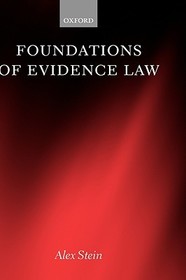
Foundations of Evidence Law
- Publisher's listprice GBP 132.50
-
59 823 Ft (56 975 Ft + 5% VAT)
The price is estimated because at the time of ordering we do not know what conversion rates will apply to HUF / product currency when the book arrives. In case HUF is weaker, the price increases slightly, in case HUF is stronger, the price goes lower slightly.
- Discount 10% (cc. 5 982 Ft off)
- Discounted price 53 841 Ft (51 278 Ft + 5% VAT)
Subcribe now and take benefit of a favourable price.
Subscribe
59 823 Ft

Availability
printed on demand
Why don't you give exact delivery time?
Delivery time is estimated on our previous experiences. We give estimations only, because we order from outside Hungary, and the delivery time mainly depends on how quickly the publisher supplies the book. Faster or slower deliveries both happen, but we do our best to supply as quickly as possible.
Product details:
- Publisher OUP Oxford
- Date of Publication 25 August 2005
- ISBN 9780198257363
- Binding Hardback
- No. of pages264 pages
- Size 242x162x19 mm
- Weight 545 g
- Language English 0
Categories
Short description:
This is the first book to systematically examine the underlying theory of evidence in Anglo-American legal systems. Stein develops a detailed and innovative theory which sets aside the traditional vision of evidence law as facilitating the discovery of the truth. Combining probability theory, epistemology, economic analysis, and moral philosophy, he argues instead that the fundamental purpose of evidence law is to apportion the risk of error in conditions of uncertainty.
MoreLong description:
This book examines systematically the underlying theory of evidence in Anglo-American legal systems and identifies the defining characteristics of adjudicative fact-finding. Stein develops a detailed innovative theory which sets aside the traditional vision of evidence law as facilitating the discovery of the truth. Combining probability theory, epistemology, economic analysis, and moral philosophy; he argues instead that the fundamental purpose of evidence law is to apportion the risk of error in conditions of uncertainty. Stein begins by identifying the domain of evidence law.He then describes the basic traits of adjudicative fact-finding and explores the epistemological foundations of the concept. This discussion identifies the problem of probabilistic deduction that accompanies generalizations to which fact-finders resort. This problem engenders paradoxes which Stein proposes to resolve by distinguishing between probability and weight. Stein advances the principle of maximal individualization that does not allow factfinders to make a finding against a person when the evidence they use is not susceptible to individualized testing.He argues that this principle has broad application, but may still be overridden by social utility. This analysis identifies allocation of the risk of error as requiring regulation by evidence law. Advocating a principled allocation of the risk of error, Stein denounces free proof for allowing individual judges to apportion this risk as they deem fit.He criticizes the UK's recent shift to a discretionary regime on similar grounds. Stein develops three fundamental principles for allocating the risk of error: the cost-efficiency principle which applies across the board; the equality principle which applies in civil litigation; and the equal best principle which applies in criminal trials. The cost-efficiency principle demands that fact-finders minimize the total cost of errors and error-avoidance.Under the equality principle, fact-finding procedures and decisions must not produce an unequal apportionment of the risk of error between the claimant and the defendant. This risk should be apportioned equally between the parties. The equal best principle sets forth two conditions for justifiably convicting and punishing a defendant. The state must do its best to protect the defendant from the risk of erroneous conviction and must not provide better protection to other individuals. Regulating both the admissibility of evidence and its sufficiency, these principles explain and justify many existing evidentiary rules. Alex Stein is Professor of Law at the Benjamin N.Cardozo School of Law,New York.
the most provocative of evidence books ... constitutes the most sophisticated and persuasive argument for enormously enhanced legal control over the evidentiary process in recent memory, and stands in marked contrast to the progression of the law of evidence in the Anglo-American world...Foundational to [Stein's] call for intense control over the evidentiary process is his deep insight that rules of evidence do not just do what they purport to do; they also allocate error, like it or not. He is right on this point...
[he] articulates an elegant unified theory of evidence law ... From these theoretical perspectives, he brilliantly critiques various evidentiary rules...[and] provides a creative theoretical foundation for both civil and criminal litigation.
Table of Contents:
ACKNOWLEDGEMENTS
PREFACE
I. GROUNDWORK
II. EPISTEMOLOGICAL COROLLARY
III. UNDERSTANDING THE LAW OF EVIDENCE THROUGH PARADOXES OF RATIONAL BELIEF
IV. EVIDENCE LAW: WHAT IS IT FOR?
V. COST-EFFICIENCY
VI. ALLOCATION OF THE RISK OF ERROR IN CRIMINAL TRIALS
VII. ALLOCATION OF THE RISK OF ERROR IN CIVIL LITIGATION

