

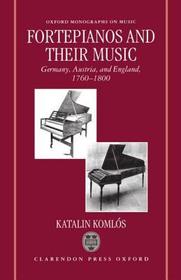
Fortepianos and their Music
Germany, Austria, and England, 1760-1800
Series: Oxford Monographs on Music;
- Publisher's listprice GBP 147.50
-
70 468 Ft (67 112 Ft + 5% VAT)
The price is estimated because at the time of ordering we do not know what conversion rates will apply to HUF / product currency when the book arrives. In case HUF is weaker, the price increases slightly, in case HUF is stronger, the price goes lower slightly.
- Discount 10% (cc. 7 047 Ft off)
- Discounted price 63 421 Ft (60 401 Ft + 5% VAT)
Subcribe now and take benefit of a favourable price.
Subscribe
70 468 Ft

Availability
printed on demand
Why don't you give exact delivery time?
Delivery time is estimated on our previous experiences. We give estimations only, because we order from outside Hungary, and the delivery time mainly depends on how quickly the publisher supplies the book. Faster or slower deliveries both happen, but we do our best to supply as quickly as possible.
Product details:
- Publisher Clarendon Press
- Date of Publication 6 April 1995
- ISBN 9780198164265
- Binding Hardback
- No. of pages172 pages
- Size 241x162x15 mm
- Weight 428 g
- Language English
- Illustrations music examples, tables 0
Categories
Short description:
The pianoforte became increasingly popular during the last third of the eighteenth century. By then, two fundamentally different types of mechanical construction had developed: the German/Viennese and the English, and these different characteristics were reflected in the keyboard music of the time. This book explores the relationship between instruments, composers, and performers at the time of Haydn, Mozart, Clementi, and the young Beethoven.
MoreLong description:
Eighteenth-century pianos shaped and influenced the music that was written for them. However, although organological studies probe the instrument in ever more detail, and musical criticism focuses increasingly on the musical repertoire, the relationship between the two has not been properly examined.
This book concentrates on the keyboard writing of the last third of the eighteenth century, as inspired by the fundamentally different constructions of the German/Viennese and the English pianoforte. The highly articulated languages of Mozart and his Viennese contemporaries, and the more robust, pre-romantic style of Duzzek and his London colleagues reflect the very characteristics of these respective instruments. Beyond the scrutiny of the music, attention is given also to the players. The differentiation between professionals and amateurs is addressed, and contemporary sources help provide a description of late-eighteenth-century performing styles; such a survey offers new insight into the living art of the pianoforte during a most important period in its history.
The long discussion of Haydn's trios and songs is an important strength of the volume.

