

- Publisher's listprice GBP 9.99
-
4 510 Ft (4 295 Ft + 5% VAT)
The price is estimated because at the time of ordering we do not know what conversion rates will apply to HUF / product currency when the book arrives. In case HUF is weaker, the price increases slightly, in case HUF is stronger, the price goes lower slightly.
- Discount 20% (cc. 902 Ft off)
- Discounted price 3 608 Ft (3 436 Ft + 5% VAT)
- Discount is valid until: 30 June 2026
Subcribe now and take benefit of a favourable price.
Subscribe
4 510 Ft

Availability
Estimated delivery time: In stock at the publisher, but not at Prospero's office. Delivery time approx. 3-5 weeks.
Not in stock at Prospero.
Why don't you give exact delivery time?
Delivery time is estimated on our previous experiences. We give estimations only, because we order from outside Hungary, and the delivery time mainly depends on how quickly the publisher supplies the book. Faster or slower deliveries both happen, but we do our best to supply as quickly as possible.
Product details:
- Edition number 2
- Publisher OUP Oxford
- Date of Publication 27 February 2020
- ISBN 9780198834410
- Binding Paperback
- No. of pages160 pages
- Size 174x111x8 mm
- Weight 120 g
- Language English
- Illustrations 17 black and white illustrations 0
Categories
Short description:
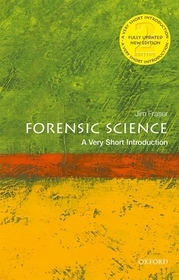
Jim Fraser explains the forensic techniques used in the investigation of crime, such as DNA profiling, toxicology, trace evidence, digital forensics, fingerprints, and crime scene management, and how forensic scientists work alongside criminal investigators and lawyers.
MoreLong description:
Forensic science is a subject of wide fascination. What happens at a crime scene? How does DNA profiling work? How can it help solve crimes that happened 20 years ago? In forensic science, a criminal case can often hinge on a piece of evidence such as a hair, a blood trace, half a footprint, or a tyre mark. Complex scientific findings must be considered carefully and dispassionately, and communicated with clarity, simplicity, and precision. High profile cases such as the Stephen Lawrence enquiry and the Madeleine McCann case have attracted enormous media attention and enhanced general interest in this area in recent years.
In this Very Short Introduction, Jim Fraser introduces the concept of forensic science and explains how it is used in the investigation of crime. He begins at the crime scene itself, explaining the principles and processes of crime scene management, and drawing on his own personal experience of high profile cases including, the murder of Rachel Nickell and the unsolved murder of Jill Dando. Fraser explores how forensic scientists work; from the reconstruction of events to laboratory examinations. He considers the techniques they use, such as fingerprinting, and goes on to highlight the immense impact DNA profiling has had. Providing examples from forensic science cases in the UK, US, and other countries, he considers the techniques and challenges faced around the world. This new edition has been fully updated to take into account developments in areas such as DNA analysis and drug analysis, and the growing field of digital forensics. Topical areas explored include the growing significance of cognitive bias in forensic science, and recent research that raises doubts about the validity of some forensic techniques.
ABOUT THE SERIES:
The Very Short Introductions series from Oxford University Press contains hundreds of titles in almost every subject area. These pocket-sized books are the perfect way to get ahead in a new subject quickly. Our expert authors combine facts, analysis, perspective, new ideas, and enthusiasm to make interesting and challenging topics highly readable.
Well written and accessible... [and] does not shy away from the various controversies that have come to plague the discipline of forensic science in recent years.
Table of Contents:
Preface and acknowledgements to second edition
What is forensic science
Investigating crime
Crime scene management and forensic investigation
Laboratory examination: search, recovery, and analysis
DNA: identity, relationships, and databases
Prints and marks: more ways to identify people and things
Trace evidence
Drugs and toxicology
Science and justice - a case study
Further reading
Index

