

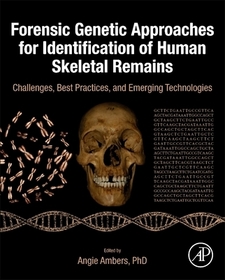
Forensic Genetic Approaches for Identification of Human Skeletal Remains
Challenges, Best Practices, and Emerging Technologies
- Publisher's listprice EUR 132.00
-
54 747 Ft (52 140 Ft + 5% VAT)
The price is estimated because at the time of ordering we do not know what conversion rates will apply to HUF / product currency when the book arrives. In case HUF is weaker, the price increases slightly, in case HUF is stronger, the price goes lower slightly.
- Discount 10% (cc. 5 475 Ft off)
- Discounted price 49 272 Ft (46 926 Ft + 5% VAT)
Subcribe now and take benefit of a favourable price.
Subscribe
54 747 Ft

Availability
Estimated delivery time: In stock at the publisher, but not at Prospero's office. Delivery time approx. 3-5 weeks.
Not in stock at Prospero.
Why don't you give exact delivery time?
Delivery time is estimated on our previous experiences. We give estimations only, because we order from outside Hungary, and the delivery time mainly depends on how quickly the publisher supplies the book. Faster or slower deliveries both happen, but we do our best to supply as quickly as possible.
Product details:
- Publisher Elsevier Science
- Date of Publication 16 November 2022
- ISBN 9780128157664
- Binding Hardback
- No. of pages626 pages
- Size 235x191 mm
- Weight 1070 g
- Language English 263
Categories
Long description:
Forensic Genetic Approaches for Identification of Human Skeletal Remains: Challenges, Best Practices, and Emerging Technologies provides best practices on processing bone samples for DNA testing. The book outlines forensic genetics tools that are available for the identification of skeletal remains in contemporary casework and historical/archaeological investigations. Although the book focuses primarily on the use of DNA for direct identification or kinship analyses, it also highlights complementary disciplines often used in concert with genetic data to make positive identifications, such as forensic anthropology, forensic odontology, and forensic art/sculpting.
Unidentified human remains are often associated with tragic events, such as fires, terrorist attacks, natural disasters, war conflicts, genocide, airline crashes, homicide, and human rights violations under oppressive totalitarian regimes. In these situations, extensive damage to soft tissues often precludes the use of such biological samples in the identification process. In contrast, bone material is the most resilient, viable sample type for DNA testing. DNA recovered from bone often is degraded and in low quantities due to the effects of human decomposition, environmental exposure, and the passage of time. The complexities of bone microstructure and its rigid nature make skeletal remains one of the most challenging sample types for DNA testing.
Table of Contents:
1. Missing persons and unidentified human remains: The world's silent mass disaster
2. Challenges in forensic genetic investigations of decomposed or skeletonized human remains: Environmental exposure, DNA degradation, inhibitors, and low copy number (LCN)
I. Guidelines and best practices for handling and processing human skeletal remains for genetic studies
3. Facilities design and workflow considerations for processing unidentified human skeletal remains
4. Location, recovery, and excavation of human remains for forensic testing
5. Skeletal microstructure, bone diagenesis, optimal sample selection, and pre-processing preparation techniques for DNA testing
6. DNA extraction methods for human skeletal remains
7. Quantitative and qualitative assessment of DNA recovered from human skeletal remains
II. Types of DNA markers and applications for identification
8. Autosomal short tandem repeat (STR) profiling of human
9. Y-chromosome analysis for unidentified human remains (UHR) investigations
10. Mitochondrial DNA and its use in the forensic analysis of skeletal material
11. X-chromosome short tandem repeats (X-STRs): Applications for human remains identification
12. Single nucleotide polymorphisms (SNPs): Ancestry-, phenotype-, and identity-informative SNPs
13. Diallelic Markers: INDELs and INNULs
III. Traditional platforms, alternative strategies, and emerging technologies for DNA analysis of human skeletal remains
14. Genotyping and sequencing of DNA recovered from human skeletal remains using capillary electrophoresis (CE)
15. Rapid DNA identification of human skeletal remains
16. Emerging technologies for DNA analysis of challenged samples
IV. Analysis of genetic data recovered from skeletonized human remains
17. Best practices in the development and effective use of a forensic DNA database for identification of missing persons and unidentified human remains
18. Software and database functionality for direct identification and kinship analysis: The Mass Fatality Identification System (M-FISys)
19. Bioinformatic tools for interrogating DNA recovered from human skeletal remains
20. The emerging discipline of forensic genetic genealogy
V. Complementary and multidisciplinary approaches to assist in identification of unidentified human skeletal remains
21. Forensic anthropology in a DNA world: How anthropological methods complement DNA-based identification of human remains
22. Generation of a personal chemical profile from skeletonized human remains
23. Forensic odontology: Historical perspectives and current applications for identification of human remains
24. Forensic facial reconstruction of skeletonized and highly decomposed human remains

