

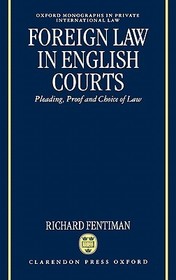
Foreign Law in English Courts
Pleading, Proof and Choice of Law
Series: Oxford Private International Law Series;
- Publisher's listprice GBP 245.00
-
110 617 Ft (105 350 Ft + 5% VAT)
The price is estimated because at the time of ordering we do not know what conversion rates will apply to HUF / product currency when the book arrives. In case HUF is weaker, the price increases slightly, in case HUF is stronger, the price goes lower slightly.
- Discount 10% (cc. 11 061 Ft off)
- Discounted price 99 556 Ft (94 815 Ft + 5% VAT)
Subcribe now and take benefit of a favourable price.
Subscribe
110 617 Ft

Availability
printed on demand
Why don't you give exact delivery time?
Delivery time is estimated on our previous experiences. We give estimations only, because we order from outside Hungary, and the delivery time mainly depends on how quickly the publisher supplies the book. Faster or slower deliveries both happen, but we do our best to supply as quickly as possible.
Product details:
- Publisher OUP Oxford
- Date of Publication 25 June 1998
- ISBN 9780198258780
- Binding Hardback
- No. of pages368 pages
- Size 242x162x24 mm
- Weight 723 g
- Language English 0
Categories
Short description:
The pleading and proof of foreign law are often treated as matters of peripheral importance. But, in reality, how foreign law is established, and whether it must be established at all, are central issues in private international law. Whether litigants are free to ignore the foreign elements in a dispute goes to the heart of the conflicts process, and without effective means to establish foreign law the very purpose of that process is subverted. Such issues give rise to particular problems in English law. It is often unclear whether the rules for choice of law are mandatory, and whether the application of foreign law is therefore required. The cost and uncertainty of establishing foreign law may also affect how cases are argued and decided, and may discourage litigants from suing at all. This book, the first to examine the topic from the perspective of English law, offers a radical reappraisal of a long-neglected subject.
MoreLong description:
How foreign law is established, and whether it must be relied upon at all, are central issues in private international law, with important implications in principle and in practice. Whether litigants are free to ignore the foreign elements in a dispute goes to the heart of the conflicts process, and without effective means to establish the content of foreign law the object of that process is undermined. The cost and unpredictability of establishing foreign law also have an important impact on litigation, affecting the parties' choice of forum, and how cases are argued and decided.
This book, the first detailed examination of the topic in English law, is an account of the pleading and proof of foreign law from an English perspective, which also places the law in a comparative context, and considers options for reform. It provides a practical guide to the subject, but also presents the conflicts process in a way which is both novel and illuminating.
Recognized as the leading account of the subject, this book is the first point of reference for both scholars and practitioners. It is frequently cited with approval in the courts, in England and elsewhere, notably in leading cases such as MCC v Bishopsgate Investments (1998, Court of Appeal), Shaker v Al Bedrawi (Court of Appeal, 2002), and Neilson v Overseas Projects Corporation (High Court of Australia, 2005).
a most important contribution to a gradual approximation of common law and civil law approaches to the subject
Table of Contents:
I Introduction
Introduction
II Legal Risk and Multistate Transactions
Managing Litigation Risk
Managing Transaction Risk
III The Laws Governing Multistate Litigation
The Laws Governing Multistate Transactions
The Dynamics of Choice of Law
The Content of Foreign Law
IV Commencing Proceedings
Strategic Choices
The Framework of Jurisdiction
Establishing Jurisdiction
V Preventing Proceedings
Excluded Claims
Declining Jurisdiction: Regulation 44/2001
Declining Jurisdiction: Residual Rules
Procedural Objections
Preclusive Proceedings
Restraining Foreign Proceedings
VI Recovery and Enforcement
Recovering Transaction Loss
Preserving Judgment Assets
Enforcing Judgment Debts

