

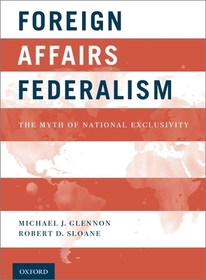
Foreign Affairs Federalism
The Myth of National Exclusivity
- Publisher's listprice GBP 83.00
-
37 474 Ft (35 690 Ft + 5% VAT)
The price is estimated because at the time of ordering we do not know what conversion rates will apply to HUF / product currency when the book arrives. In case HUF is weaker, the price increases slightly, in case HUF is stronger, the price goes lower slightly.
- Discount 10% (cc. 3 747 Ft off)
- Discounted price 33 727 Ft (32 121 Ft + 5% VAT)
Subcribe now and take benefit of a favourable price.
Subscribe
37 474 Ft

Availability
Uncertain availability. Please turn to our customer service.
Why don't you give exact delivery time?
Delivery time is estimated on our previous experiences. We give estimations only, because we order from outside Hungary, and the delivery time mainly depends on how quickly the publisher supplies the book. Faster or slower deliveries both happen, but we do our best to supply as quickly as possible.
Product details:
- Publisher OUP USA
- Date of Publication 26 May 2016
- ISBN 9780199941490
- Binding Hardback
- No. of pages432 pages
- Size 236x155x35 mm
- Weight 680 g
- Language English 0
Categories
Short description:
Foreign Affairs Federalism studies the constitutional allocation of foreign affairs powers between the federal government and the states. It explains the current law clearly and accessibly, identifying those areas where the law can be confidently ascertained. Where the law cannot be determined, the authors suggest the most plausible or compelling perspectives on existing doctrine.
MoreLong description:
In the U.S. legal system, the federal government has traditionally been the only rightful arena for the conduct of foreign affairs, especially in the case of national security, military action, international trade, and treaty-making. However, the pervasiveness of globalization and the attendant ease of cross-border interactions, with implications for commerce and terrorism, have brought U.S. states, counties, and municipalities increasingly into the federal government's long-standing province of international relations. For example, states now forge trade relationships with foreign governments through energy and investment contracts that very much resemble treaties. If a foreign sovereign violates any of these contracts or statutes, then civil or criminal action against that sovereign could interfere with the U.S. federal government's diplomatic relations overseas. Consequently, the legal status of states and local governments in the conduct of foreign affairs is unclear and in need of thoughtful analysis and guidance. In Foreign Affairs Federalism, Michael Glennon and Robert Sloane study the constitutional allocation of foreign affairs powers between the federal government and the states. They explain the current law clearly and accessibly, identifying those areas where the law can be confidently ascertained. Where the law cannot be determined, they suggest the most plausible or compelling perspectives on existing doctrine. They also appraise existing doctrine against the background of the diverse and incompatible goals and challenges facing the United States in the twenty-first century.
Foreign Affairs Federalism supplies an important description and analysis of the full range of state and local activity implicating foreign relations, a welcome first book-length treatment of the subject. Foreign Affairs Federalism will help lead constitutional actors, not least the courts, to understand the normalization of the subnational role in global affairs. The issue will become only more important in coming years as political polarization moves beyond the water's edge.
Table of Contents:
Preface
Acknowledgments
CHAPTER 1
WHY EMPOWER STATES?
CHAPTER 2
STATES, CITIES, AND GLOBALIZATION
CHAPTER 3
CONSTITUTIONAL METHODOLOGY AND THE ROLE OF THE COURTS
CHAPTER 4
DORMANT FOREIGN AFFAIRS PREEMPTION
CHAPTER 5
THE DORMANT FOREIGN COMMERCE POWER
CHAPTER 6
THE TREATY POWER
CHAPTER 7
FEDERAL COMMON LAW AND STATE POWER
CHAPTER 8
FEDERAL APPROVAL: THE COMPACT CLAUSE
CHAPTER 9
FEDERAL DISAPPROVAL
CHAPTER 10
A CASE STUDY: STATES AS CYBER-DEFENDERS
CHAPTER 11
CONCLUSION
Index

