

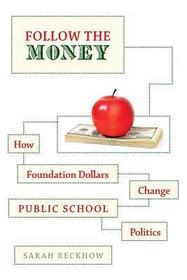
Follow the Money
How Foundation Dollars Change Public School Politics
Series: Studies in Postwar American Political Development;
- Publisher's listprice GBP 41.99
-
18 958 Ft (18 055 Ft + 5% VAT)
The price is estimated because at the time of ordering we do not know what conversion rates will apply to HUF / product currency when the book arrives. In case HUF is weaker, the price increases slightly, in case HUF is stronger, the price goes lower slightly.
- Discount % (cc. 0 Ft off)
- Discounted price 0 Ft (0 Ft + 5% VAT)
Subcribe now and take benefit of a favourable price.
Subscribe
18 958 Ft

Availability
printed on demand
Why don't you give exact delivery time?
Delivery time is estimated on our previous experiences. We give estimations only, because we order from outside Hungary, and the delivery time mainly depends on how quickly the publisher supplies the book. Faster or slower deliveries both happen, but we do our best to supply as quickly as possible.
Product details:
- Publisher OUP USA
- Date of Publication 22 January 2015
- ISBN 9780190227340
- Binding Paperback
- No. of pages236 pages
- Size 231x155x17 mm
- Weight 340 g
- Language English
- Illustrations 13 figures and 13 tables 0
Categories
Short description:
In Follow the Money, Sarah Reckhow shows where and how foundation investment in education is occurring and presents in-depth analysis of the effects of these investments within the two largest urban districts in the United States: New York City and Los Angeles.
MoreLong description:
Some of the nation's wealthiest philanthropic organizations, including the Bill and Melinda Gates Foundation, the Walton Family Foundation, and the Broad Foundation, have invested hundreds of millions of dollars in education reform. With vast wealth and a political agenda, these foundations have helped to reshape the reform landscape in urban education. In Follow the Money, Sarah Reckhow shows where and how foundation investment in education is occurring and provides a penetrating analysis of the effects of these investments in the two largest urban districts in the United States: New York City and Los Angeles.
In New York City, centralized political control and the use of private resources have enabled rapid implementation of reform proposals. Yet this potent combination of top-down authority and outside funding also poses serious questions about transparency, responsiveness, and democratic accountability in New York. Furthermore, the sustainability of reform policies is closely linked to the political fortunes of the current mayor and his chosen school leader. While the media has highlighted the efforts of forceful reformers and dominating leaders such as Joel Klein in New York City and Michelle Rhee in Washington, D.C., a slower, but possibly more transformative, set of reforms have been taking place in Los Angeles. These reforms were also funded and shaped by major foundations, but they work from the bottom up, through charter school operators managing networks of schools. This strategy has built grassroots political momentum and demand for reform in Los Angeles that is unmatched in New York City and other districts with mayoral control. Reckhow's study of Los Angeles's education system shows how democratically responsive urban school reform could occur-pairing foundation investment with broad grassroots involvement.
Bringing a sharp analytical eye and a wealth of evidence to one of the most politicized issues of our day, Follow the Money will reshape our thinking about educational reform in America.
Sarah Reckhow has written a timely and fascinating book that brings overdue attention to the impact of philanthropy on education policy. In this extraordinarily thoughtful account, she explains how major donors are influencing school reform. In a field alternately dominated by fawning accounts and ad hominem attacks, Reckhow has provided a signal service. This is a book I heartily recommend to scholars, educators, policymakers, and would-be reformers.
Table of Contents:
Introduction: The Boardroom Progressives
Chapter 1: Accountability, Markets, and the Philanthropic Agenda
Chapter 2: Following the Money from Foundations to Urban School Districts
Chapter 3: From Annenberg to Gates
Chapter 4: A Shadow Bureaucracy
Chapter 5: Deliberative Decentralization
Conclusions and Implications
Appendix A: Top 15 Grant-makers to K-12 Education, 2000 and 2005
Appendix B: Grant Recipient Categories
Appendix C: Explanation of Data
Appendix D: Surveys
References
Notes
Index

