

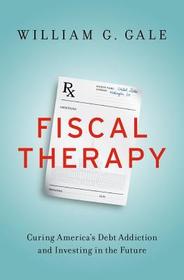
Fiscal Therapy
Curing America's Debt Addiction and Investing in the Future
- Publisher's listprice GBP 35.49
-
16 955 Ft (16 147 Ft + 5% VAT)
The price is estimated because at the time of ordering we do not know what conversion rates will apply to HUF / product currency when the book arrives. In case HUF is weaker, the price increases slightly, in case HUF is stronger, the price goes lower slightly.
- Discount 10% (cc. 1 696 Ft off)
- Discounted price 15 259 Ft (14 532 Ft + 5% VAT)
Subcribe now and take benefit of a favourable price.
Subscribe
16 955 Ft

Availability
Estimated delivery time: In stock at the publisher, but not at Prospero's office. Delivery time approx. 3-5 weeks.
Not in stock at Prospero.
Why don't you give exact delivery time?
Delivery time is estimated on our previous experiences. We give estimations only, because we order from outside Hungary, and the delivery time mainly depends on how quickly the publisher supplies the book. Faster or slower deliveries both happen, but we do our best to supply as quickly as possible.
Product details:
- Publisher OUP USA
- Date of Publication 2 May 2019
- ISBN 9780190645410
- Binding Hardback
- No. of pages352 pages
- Size 163x236x27 mm
- Weight 635 g
- Language English 0
Categories
Short description:
Fiscal Therapy takes a critical look at how and why the U.S. has run up its debt so high in the last four decades, what other countries have done to dig themselves out of this level of red ink, and what needs to be done now if the U.S. is to avoid bankruptcy in the 2050s and beyond.
MoreLong description:
Fiscal Therapy shows how to make America's economy stronger and fairer by meeting long-term budget challenges while also addressing its short-term need for more investment and better social policy.
America is facing a double-edged sword of budget challenges. In the coming decades, rising public debt will hurt our economy, threaten our global leadership, and reduce the living standards of our people. It will require tax increases and spending cuts to bring about a sustainable outcome. At the same time, however, America has pressing needs -- from improving our schools and making child care more available to rebuilding our infrastructure and investing more in scientific research -- all of which require upfront investments right now.
In Fiscal Therapy, William Gale diagnoses these two set of challenges and explains why we must address them simultaneously. Fiscal Therapy shows that we can address our long-term budget challenges in ways that also help us meet our short-term needs, and we can do so without radically transforming our current institutions and existing programs.
Gale draws lessons from the nation's history; takes guidance from the experiences of other advanced nations; reconciles the twin demands of economic growth and social fairness; and addresses the obstacles that America's poisonous politics and fickle public opinion present.
Fiscal Therapy provides a clear, comprehensive, and optimistic approach around which liberals and conservatives can rally. One that will leave the United States a stronger, more prosperous, and fairer nation.
Dealing with fiscal deficits and government debt is important, but the discussion is so discomforting that it risks turning people off. Fortunately, Gale does a better job than I did, and he kept me engaged until the endGale does a great job of laying out what's likely to happen if we allow deficits and debt to grow on their current paths.
Table of Contents:
INTRODUCTION
1. Introduction
THE PROBLEM
2. Meet the federal budget - basics, vocabulary, etc.
3. The Budget Outlook -- where we are headed
4. Economic Effects of Public Debt - why where we are headed is a problem
5. What would a solution look like? The right target, the fiscal gap, timing and uncertainty
ON THE ROAD TO A SOLUTION
6. History - How did we get here? What do we learn from that?
7. Growth - Effect of tax and spending policy changes on growth
8. Fairness - How income distribution and economic mobility issues affect fiscal choices
9. Politics - Political factors and public opinion as they influence fiscal policy
SOLUTIONS
10. Health care
11. Social security and retirement
12. Defense and national security
13. The safety net and government investment
14. Income tax reform
15. Corporate/business tax reform
16. Consumption tax/value-added tax
17. Energy taxes/Carbon tax
18. Budget process
CONCLUSION
19. Conclusion

