

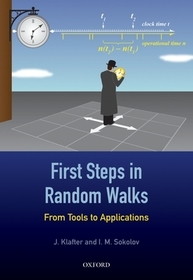
First Steps in Random Walks
From Tools to Applications
- Publisher's listprice GBP 80.00
-
36 120 Ft (34 400 Ft + 5% VAT)
The price is estimated because at the time of ordering we do not know what conversion rates will apply to HUF / product currency when the book arrives. In case HUF is weaker, the price increases slightly, in case HUF is stronger, the price goes lower slightly.
- Discount 10% (cc. 3 612 Ft off)
- Discounted price 32 508 Ft (30 960 Ft + 5% VAT)
Subcribe now and take benefit of a favourable price.
Subscribe
36 120 Ft

Availability
printed on demand
Why don't you give exact delivery time?
Delivery time is estimated on our previous experiences. We give estimations only, because we order from outside Hungary, and the delivery time mainly depends on how quickly the publisher supplies the book. Faster or slower deliveries both happen, but we do our best to supply as quickly as possible.
Product details:
- Publisher OUP Oxford
- Date of Publication 18 August 2011
- ISBN 9780199234868
- Binding Hardback
- No. of pages160 pages
- Size 254x179x14 mm
- Weight 484 g
- Language English
- Illustrations 38 line drawings 0
Categories
Short description:
Random walks proved to be a useful model of many complex transport processes at the micro and macroscopical level in physics and chemistry, economics, biology and other disciplines. The book discusses the main variants of random walks and gives the most important mathematical tools for their theoretical description.
MoreLong description:
The name "random walk" for a problem of a displacement of a point in a sequence of independent random steps was coined by Karl Pearson in 1905 in a question posed to readers of "Nature". The same year, a similar problem was formulated by Albert Einstein in one of his Annus Mirabilis works. Even earlier such a problem was posed by Louis Bachelier in his thesis devoted to the theory of financial speculations in 1900. Nowadays the theory of random walks has proved useful in physics and chemistry (diffusion, reactions, mixing in flows), economics, biology (from animal spread to motion of subcellular structures) and in many other disciplines. The random walk approach serves not only as a model of simple diffusion but of many complex sub- and super-diffusive transport processes as well. This book discusses the main variants of random walks and gives the most important mathematical tools for their theoretical description.
Most statistical physics books treat Brownian motion, but do not introduce the student to the many examples of anomalous diffusion. This is the void the Klafter-Sokolov book fills, to bring the student into contact with modern work on random walks with a unified approach. The power here is that straightforward mathematics can be employed to tackle a rich selection of problems in anomalous diffusion. One does not need to introduce many different techniques, but to successively generalize one method and apply it to topics in physics, chemistry, and biology.
Table of Contents:
Characteristic Functions
Generating Functions and Applications
Continuous Time Random Walks
CTRW and Aging Phenomena
Master Equations
Fractional Diffusion and Fokker-Planck Equations for Subdiffusion
Lévy Flights
Coupled CTRW and Lévy Walks
Simple Reactions: A+B->B
Random Walks on Percolation Structures

