

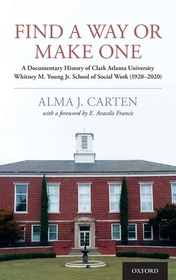
Find a Way or Make One
A Documentary History of Clark Atlanta University Whitney M. Young Jr. School of Social Work (1920-2020)
- Publisher's listprice GBP 47.99
-
22 927 Ft (21 835 Ft + 5% VAT)
The price is estimated because at the time of ordering we do not know what conversion rates will apply to HUF / product currency when the book arrives. In case HUF is weaker, the price increases slightly, in case HUF is stronger, the price goes lower slightly.
- Discount 10% (cc. 2 293 Ft off)
- Discounted price 20 634 Ft (19 652 Ft + 5% VAT)
Subcribe now and take benefit of a favourable price.
Subscribe
22 927 Ft

Availability
Estimated delivery time: In stock at the publisher, but not at Prospero's office. Delivery time approx. 3-5 weeks.
Not in stock at Prospero.
Why don't you give exact delivery time?
Delivery time is estimated on our previous experiences. We give estimations only, because we order from outside Hungary, and the delivery time mainly depends on how quickly the publisher supplies the book. Faster or slower deliveries both happen, but we do our best to supply as quickly as possible.
Product details:
- Publisher OUP USA
- Date of Publication 17 November 2020
- ISBN 9780197518465
- Binding Hardback
- No. of pages468 pages
- Size 155x236x33 mm
- Weight 794 g
- Language English 72
Categories
Short description:
This book takes readers through the history of Whitney M. Young, Jr., School of Social work at Clark Atlanta University and uncovers the strides in progress and significant contributions within the field of social work made by black scholars.
MoreLong description:
Clark Atlanta University Whitney M. Young Jr. School of Social Work was founded in 1920 in Atlanta, Georgia, as the Atlanta School of Social Work to prepare social workers for practice in underserved black neighborhoods. Spearheaded by black scholars and progressive whites during an era of racial segregation, 2020 marks its centennial as the first accredited social work program at a historically black college and university. In this book, social work professor Alma J. Carten describes the School's transitions from its beginnings amid the pervasive racism sanctioned by Supreme Court rulings in the Dred Scott and Plessy v. Ferguson cases, through the decades of 20th century progressive civil rights reforms, and into the new conservatism of the 21st century.
Referencing archival documents, Carten illustrates the School's commitment to the democratic principles of the profession despite the blatant racism of the segregated South and the less visible structural inequalities following desegregation from which mainstream social work education was not immune. The book describes the influence of iconic thought leaders on the School's culture and academic programs, beginning with Jesse O. Thomas's speech on the need for a black school of social work, given from the segregated section of the 1920 National Conference on Social Work; and including W.E.B. DuBois' Atlanta University Studies that pioneered the model of social progress powered by science; E. Franklin Frazier and Forrester B. Washington, who championed "black social work" and the integration of race critical content in the curriculum of all schools; and Whitney M. Young, Jr., who chastised social workers for their waning interest in advocacy for marginalized populations and encouraged them to become politically active.
Carten examines the evolution of the School within the context of changes in US social welfare policy, CSWE accrediting standards, and NASW Code of Ethics. Highly readable, the book brings to light the under-reported contributions of HBCU social work programs to social work education, and it thoughtfully engages with the School's efforts to legitimize the Afrocentric perspective and the humanistic values embraced by HBCU social work programs.
There is both a lack of knowledge and acknowledgement of the important contributions of Black social workers. This historical account is needed to better understand contemporary social welfare philosophies and theoretical frameworks that inform our practice and scholarship. It affirms the extraordinary commitment of Black pioneer social workers in their quest for social justice. Carten's discussions of the historical treasures from those who established the school and laid the foundation for its success is very intriguing, and I was intellectually stimulated and reaffirmed by everything revealed about the relationships and networks that existed during the early periods of our history.
Table of Contents:
Acknowledgements
Foreword
Preface
Part I: Beginnings
Chapter 1: Introduction
Chapter 2: The Historical Context
Chapter 3: The Emergence of Atlanta University
Chapter 4: Legitimating the Need
Chapter 5: The Scientific Heritage
Chapter 6: W.E.B. Dubois and Lugenia Burns Hope
Chapter 7: The Launching of the School
Part II: Moving the Legacy into the 20th Century
Chapter 8: Embracing the Black Experience
Chapter 9: Curriculum Renewal in the Post War Years
Chapter 10: Reclaiming the Legacy
Chapter 11: Shifting Social Welfare Philosophy
Part III: At the Midpoint and Beyond
Chapter 12: Crossing Over at the Bicentennial
Chapter 13: The Enduring Legacy of Whitney M. Young, Jr.
Chapter 14: The Millennium and Beyond
Chapter 15: The School enters the 21st Century
Closing Message from Dean Jenny Jones

