

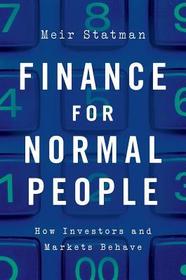
Finance for Normal People
How Investors and Markets Behave
- Publisher's listprice GBP 37.49
-
16 926 Ft (16 120 Ft + 5% VAT)
The price is estimated because at the time of ordering we do not know what conversion rates will apply to HUF / product currency when the book arrives. In case HUF is weaker, the price increases slightly, in case HUF is stronger, the price goes lower slightly.
- Discount 10% (cc. 1 693 Ft off)
- Discounted price 15 233 Ft (14 508 Ft + 5% VAT)
Subcribe now and take benefit of a favourable price.
Subscribe
16 926 Ft

Availability
printed on demand
Why don't you give exact delivery time?
Delivery time is estimated on our previous experiences. We give estimations only, because we order from outside Hungary, and the delivery time mainly depends on how quickly the publisher supplies the book. Faster or slower deliveries both happen, but we do our best to supply as quickly as possible.
Product details:
- Publisher OUP USA
- Date of Publication 29 June 2017
- ISBN 9780190626471
- Binding Hardback
- No. of pages488 pages
- Size 239x163x30 mm
- Weight 771 g
- Language English 0
Categories
Short description:
Finance for Normal People teaches behavioral finance to people like you and me - normal people, neither rational nor irrational. We are consumers, savers, investors, and managers - corporate managers, money managers, financial advisers, and all other financial professionals.
MoreLong description:
Finance for Normal People teaches behavioral finance to people like you and me - normal people, neither rational nor irrational. We are consumers, savers, investors, and managers - corporate managers, money managers, financial advisers, and all other financial professionals.
The book guides us to know our wants - including hope for riches, protection from poverty, caring for family, sincere social responsibility and high social status. It teaches financial facts and human behavior, including making cognitive and emotional shortcuts and avoiding cognitive and emotional errors such as overconfidence, hindsight, exaggerated fear, and unrealistic hope. And it guides us to banish ignorance, gain knowledge, and increase the ratio of smart to foolish behavior on our way to what we want.
These lessons of behavioral finance draw on what we know about us - normal people - including our wants, cognition, and emotions. And they draw on the roles of these factors in saving and spending, portfolio construction, returns we can expect from our investments, and whether we can hope to beat the market.
Meir Statman, a founder of behavioral finance, draws on his extensive research and the research of many others to build a unified structure of behavioral finance. Its foundation blocks include normal behavior, behavioral portfolio theory, behavioral life-cycle theory, behavioral asset pricing theory, and behavioral market efficiency.
As Pogo used to say: 'We have met the enemy and we are it.' By elucidating clearly the teachings of behavioral finance, Meir Statman shows us how to avoid the common errors investors make and how to become smarter investors.
Table of Contents:
Contents
Introduction: What is Behavioral Finance?
Part 1: Behavioral People are Normal People
Chapter 1: Normal people
Chapter 2: Our wants for utilitarian, expressive, and emotional benefits
Chapter 3: Cognitive shortcuts and errors
Chapter 4: Emotional shortcuts and errors
Chapter 5: Correcting cognitive and emotional errors
Chapter 6: Experienced happiness, life-evaluation, and choices: Expected Utility Theory and Prospect Theory
Chapter 7: Behavioral Finance Puzzles: The dividend puzzle, the disposition puzzle, and the puzzles of dollar-cost-averaging and time-diversification
Part 2: Behavioral Finance in Portfolios, Life-Cycles, Asset Prices, and Market Efficiency
Chapter 8: Behavioral portfolios
Chapter 9: Behavioral life-cycles of saving and spending
Chapter 10: Behavioral asset pricing
Chapter 11: Behavioral market efficiency
Chapter 12: Lessons of behavioral finance

