

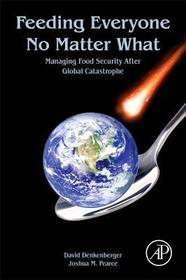
Feeding Everyone No Matter What
Managing Food Security After Global Catastrophe
- Publisher's listprice EUR 35.95
-
14 910 Ft (14 200 Ft + 5% VAT)
The price is estimated because at the time of ordering we do not know what conversion rates will apply to HUF / product currency when the book arrives. In case HUF is weaker, the price increases slightly, in case HUF is stronger, the price goes lower slightly.
- Discount 10% (cc. 1 491 Ft off)
- Discounted price 13 419 Ft (12 780 Ft + 5% VAT)
Subcribe now and take benefit of a favourable price.
Subscribe
14 910 Ft

Availability
Out of print
Why don't you give exact delivery time?
Delivery time is estimated on our previous experiences. We give estimations only, because we order from outside Hungary, and the delivery time mainly depends on how quickly the publisher supplies the book. Faster or slower deliveries both happen, but we do our best to supply as quickly as possible.
Product details:
- Publisher Academic Press
- Date of Publication 17 November 2014
- ISBN 9780128021507
- Binding Paperback
- No. of pages128 pages
- Size 229x152 mm
- Weight 200 g
- Language English 0
Categories
Long description:
Feeding Everyone No Matter What presents a scientific approach to the practicalities of planning for long-term interruption to food production.
The primary historic solution developed over the last several decades is increased food storage. However, storing up enough food to feed everyone would take a significant amount of time and would increase the price of food, killing additional people due to inadequate global access to affordable food. Humanity is far from doomed, however, in these situations - there are solutions.
This book provides an order of magnitude technical analysis comparing caloric requirements of all humans for five years with conversion of existing vegetation and fossil fuels to edible food. It presents mechanisms for global-scale conversion including: natural gas-digesting bacteria, extracting food from leaves, and conversion of fiber by enzymes, mushroom or bacteria growth, or a two-step process involving partial decomposition of fiber by fungi and/or bacteria and feeding them to animals such as beetles, ruminants (cows, deer, etc), rats and chickens. It includes an analysis to determine the ramp rates for each option and the results show that careful planning and global cooperation could ensure the bulk of humanity and biodiversity could be maintained in even in the most extreme circumstances.
- Summarizes the severity and probabilities of global catastrophe scenarios, which could lead to a complete loss of agricultural production
- More than 10 detailed mechanisms for global-scale solutions to the food crisis and their evaluation to test their viability
- Detailed roadmap for future R&D for human survival after global catastrophe
Table of Contents:
1. Introduction
2. Worldwide Crop Death: The Five Crop-killing Scenarios
3. No Sun: Three sunlight-killing scenarios
4. Food Storage, Food Conservation, and Cannibalism
5. Stopgap Food Production: Fast food
6. Fibre Supply for Conversion to Food
7. Solutions: Stored Biomass/Fossil Fuel Conversion to Food
8. Practical Matters: Energy, Water, Nutrition, Taste, Biodiversity, & Cooperation
9. Moral Hazard
10. Serious Prepping: A Guide to Necessary Research
More
