

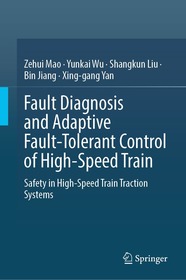
Fault Diagnosis and Adaptive Fault-Tolerant Control of High-Speed Train
Safety in High-Speed Train Traction Systems
-
GET 12% OFF
- Publisher's listprice EUR 213.99
-
83 584 Ft (79 604 Ft + 5% VAT)
The price is estimated because at the time of ordering we do not know what conversion rates will apply to HUF / product currency when the book arrives. In case HUF is weaker, the price increases slightly, in case HUF is stronger, the price goes lower slightly.
- Discount 12% (cc. 10 030 Ft off)
- Discounted price 73 554 Ft (70 052 Ft + 5% VAT)
73 554 Ft

Availability
Not yet published.
Why don't you give exact delivery time?
Delivery time is estimated on our previous experiences. We give estimations only, because we order from outside Hungary, and the delivery time mainly depends on how quickly the publisher supplies the book. Faster or slower deliveries both happen, but we do our best to supply as quickly as possible.
Product details:
- Publisher Springer Nature Singapore
- Date of Publication 14 August 2026
- ISBN 9789819594801
- Binding Hardback
- No. of pages200 pages
- Size 235x155 mm
- Language English
- Illustrations XV, 200 p. 1 illus. 700
Categories
Long description:
High-speed train with its reliable, fast and high loading capacities, has attracted more and more attention in the recent years. With the increasing requirements of the speed and safety of the train operation, a lot of efforts has been devoted to the control design for high-speed trains. Similar to the other complex systems, high-speed train formed by the sensors, motors, electrical components, mechanical drives and so on, will have failures with the long time (distance) operation, which could lead to the delay and even stop of the train. Regarded as the heart of the high-speed train, the traction system provides traction power for the entire system. The faults in the traction system may appear in different locations, such as motor, converters, control units, sensors, and so on. These faults can affect the effectiveness of traction force, and result in reduction of speed or may even stop the train. Thus, it is critical to study fault diagnosis and fault-tolerant control problem for high-speed train traction systems.
This monograph presents a systematic and comprehensive description of the problems of fault diagnosis and fault-tolerant control of high-speed train traction systems in the presence of faults, external disturbances, and unknown uncertainties. It offers readers with a deep understanding and insight into the safety of high-speed train traction systems, suspension systems and the corresponding design methods. The fault diagnosis and fault-tolerant control methods presented in this book can provide guidance to engineers to improve safety in rail transportation and other related fields. This book is suitable for scientists and researchers in the field of systems and controls, railway transportation engineers, control engineers, lecturers and teachers, graduate students, undergraduate students, and especially those working in the field of high-speed train system control.
MoreTable of Contents:
Chapter 1 Introduction.- Chapter 2 High-Speed Train Traction Systems Model.- Chapter 3 Sensor Fault Detection for Suspension Systems.-Chapter 4 Deep PCA and Kullback-Leibler Divergence Based Fault Detection.- Chapter 5 Incipient Fault Detection and Isolation for Suspension Systems.- Chapter 6 Adaptive Compensation of Traction System Actuator Failures.- Chapter 7 Adaptive Actuator Compensation of Position Tracking.- Chapter 8 Adaptive Backstepping Based Fault-tolerant Control.- Chapter 9 Adaptive Fault-Tolerant Sliding-Mode Control.- Chapter 10 Conclusions and Future Directions.
More
