

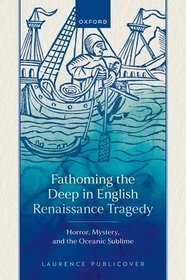
Fathoming the Deep in English Renaissance Tragedy
Horror, Mystery, and the Oceanic Sublime
- Publisher's listprice GBP 25.00
-
11 943 Ft (11 375 Ft + 5% VAT)
The price is estimated because at the time of ordering we do not know what conversion rates will apply to HUF / product currency when the book arrives. In case HUF is weaker, the price increases slightly, in case HUF is stronger, the price goes lower slightly.
- Discount 10% (cc. 1 194 Ft off)
- Discounted price 10 749 Ft (10 238 Ft + 5% VAT)
Subcribe now and take benefit of a favourable price.
Subscribe
11 943 Ft

Availability
Estimated delivery time: In stock at the publisher, but not at Prospero's office. Delivery time approx. 3-5 weeks.
Not in stock at Prospero.
Why don't you give exact delivery time?
Delivery time is estimated on our previous experiences. We give estimations only, because we order from outside Hungary, and the delivery time mainly depends on how quickly the publisher supplies the book. Faster or slower deliveries both happen, but we do our best to supply as quickly as possible.
Product details:
- Publisher OUP Oxford
- Date of Publication 1 October 2024
- ISBN 9780198907084
- Binding Hardback
- No. of pages224 pages
- Size 20x240x164 mm
- Weight 494 g
- Language English
- Illustrations 5 660
Categories
Short description:
This scholarly but accessible book offers fresh readings of canonical plays including Hamlet, King Lear, Macbeth, and The Duchess of Malfi, while also intervening in recent critical debates concerning the work and the history of tragedy and reflecting on what it means to read these plays in a time of environmental crisis.
MoreLong description:
This book demonstrates how a group of tragedies by Shakespeare and his contemporaries stage the fear and exhilaration generated by encounters with the unknown and the extraordinary. Arguing that the maritime art of fathoming--that is, dropping a lead and line into water to measure its depth--operates as a master-image for these plays, it illustrates how they create sublime horror through intuitions of mysterious more-than-human agencies and of worlds beyond the visible.
Though tightly focused on a specific body of imagery, the book strikes up dialogue with a number of critical fields, including theories and histories of tragedy; ecocriticism and the environmental humanities; oceanic studies; and work on early modern ideas about the body, madness, and language. Countering a tendency within tragic theory to value the textual over the dramatic, it also demonstrates how the tragic effects to which it points are created through specific theatrical strategies, including the use of offstage space, intertheatricality, and the violation of dramatic conventions. Situating its arguments within recent criticism on these plays and on tragedy more generally, and pushing back against scholarship that regards the genre in Shakespeare's time as concerned more with pity than with fear, the book offers fresh and detailed readings of some of the most frequently studied plays in the English canon, including Hamlet, King Lear, Macbeth, The Duchess of Malfi, and The Changeling.
Original, absorbing, persuasive, and beautifully written: throughout this book, Publicover reveals tragedies' recurring preoccupation with the uneasy experience of stumbling on, or near, hidden mysteries. Even more important, he shows why a language of depth and descent matters for our thinking about tragedy more broadly: it reflects the genre's fundamental investment not simply in affective power, but also in an epistemological abyss that triggers a more all-consuming disorientation. His readings are not only beautiful but moving: this is a rare and unforgettable achievement.
Table of Contents:
Introduction: Horatio's Warnings
The Spanish Tragedy and the English Tradition
Fathoming King Lear
The Horror of Macbeth
Peering into the Beyond: The Duchess of Malfi
Middleton's Deep
Conclusion: Tragedy, History, and Ecological Thought

