

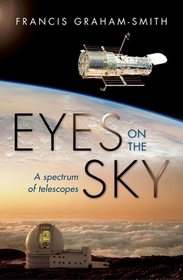
Eyes on the Sky
A Spectrum of Telescopes
- Publisher's listprice GBP 30.49
-
14 566 Ft (13 872 Ft + 5% VAT)
The price is estimated because at the time of ordering we do not know what conversion rates will apply to HUF / product currency when the book arrives. In case HUF is weaker, the price increases slightly, in case HUF is stronger, the price goes lower slightly.
- Discount 10% (cc. 1 457 Ft off)
- Discounted price 13 109 Ft (12 485 Ft + 5% VAT)
Subcribe now and take benefit of a favourable price.
Subscribe
14 566 Ft

Availability
Estimated delivery time: Expected time of arrival: end of January 2026.
Not in stock at Prospero.
Why don't you give exact delivery time?
Delivery time is estimated on our previous experiences. We give estimations only, because we order from outside Hungary, and the delivery time mainly depends on how quickly the publisher supplies the book. Faster or slower deliveries both happen, but we do our best to supply as quickly as possible.
Product details:
- Publisher OUP Oxford
- Date of Publication 23 June 2016
- ISBN 9780198734277
- Binding Hardback
- No. of pages252 pages
- Size 240x172x25 mm
- Weight 512 g
- Language English
- Illustrations 92 black and white halftones 0
Categories
Short description:
Astronomy is experiencing a golden age, with a new generation of innovative telescopes yielding a flood of information on the Universe. This book traces the development of telescopes from Galileo to the present day, and explains the basic principles of telescopes that operate in different parts of electromagnetic spectrum.
MoreLong description:
Four centuries ago, Galileo first turned a telescope to look up at the night sky. His discoveries opened the cosmos, revealing the geometry and dynamics of the solar system. Today's telescopic equipment, stretching over the whole spectrum from visible light to radio and millimetre astronomy, through infrared to ultraviolet, X-rays and gamma rays, has again transformed our understanding of the whole Universe.
In this book Francis Graham-Smith explains how this technology can be engaged to give us a more in-depth picture of the nature of the universe. Looking at both ground-based telescopes and telescopes on spacecraft, he analyses their major discoveries, from planets and pulsars to cosmology. Large research teams and massive data handling are necessary, but the excitement of discovery is increasingly shared by a growing public, who can even join in some of the analysis by remote computer techniques. Observational astronomy has become international. All major projects are now partnerships; most notably the Square Kilometre Array, which will involve astronomers from over 100 countries and will physically exist in several of them. Covering the history and development of telescopes from Galileo to the present day, Eyes on the Sky traces what happens when humankind looks up.
The book offers a very nice historic survey of telescopes and the related techniques for astronomical observations in all parts of the spectrum, and should be a good read for anyone interested in the subject.
Table of Contents:
Galileo opens the sky
The big reflecting telescopes
How to build bigger telescopes
Stretching the spectrum: Infrared and ultraviolet.
Into Space
X-rays
Gamma rays and cosmic rays
Radio telescopes
Pairs and arrays
Millimetre waves and spectral lines
Opening the cosmos
Then, now, and tomorrow
Further reading
Index

