

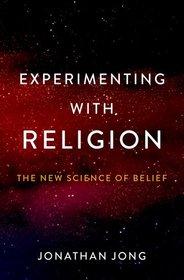
Experimenting with Religion
The New Science of Belief
- Publisher's listprice GBP 20.99
-
9 476 Ft (9 025 Ft + 5% VAT)
The price is estimated because at the time of ordering we do not know what conversion rates will apply to HUF / product currency when the book arrives. In case HUF is weaker, the price increases slightly, in case HUF is stronger, the price goes lower slightly.
- Discount 20% (cc. 1 895 Ft off)
- Discounted price 7 581 Ft (7 220 Ft + 5% VAT)
- Discount is valid until: 30 June 2026
Subcribe now and take benefit of a favourable price.
Subscribe
9 476 Ft

Availability
Estimated delivery time: In stock at the publisher, but not at Prospero's office. Delivery time approx. 3-5 weeks.
Not in stock at Prospero.
Why don't you give exact delivery time?
Delivery time is estimated on our previous experiences. We give estimations only, because we order from outside Hungary, and the delivery time mainly depends on how quickly the publisher supplies the book. Faster or slower deliveries both happen, but we do our best to supply as quickly as possible.
Product details:
- Publisher OUP USA
- Date of Publication 9 June 2023
- ISBN 9780190875541
- Binding Hardback
- No. of pages200 pages
- Size 164x236x19 mm
- Weight 426 g
- Language English 410
Categories
Short description:
This book showcases several experiments as examples of how psychologists can study religion and spirituality, casting a light on both the ingenuity and limitations of each. Ultimately, this book demonstrates that such scientific experiments are works of imagination that can help us discover truths about the human mind's proclivity for religious ideas, as long as we can adapt and learn along the way.
MoreLong description:
Across history, our understanding of God, the soul, spirituality, and even science itself has shifted dramatically. Today, we have more scientific knowledge than ever, yet some age-old questions persist: Why do we believe in gods, souls, and rituals? Are these beliefs innate? Do existential fears drive us toward or away from religion? What can we learn about spirituality from children? How can we leverage scientific thinking to study spirituality?
This book invites you into the labs and minds of some of the world's most renowned psychological scientists for an in-depth look at how psychologists can study religion and spirituality-and how they wrestle with doubts about ostensibly established findings and methods, even as the field advances. From China, India, Brazil, the United Kingdom, the United States, and Tuva, this book takes a balanced perspective on a diverse range of experiments and studies, casting a light on both their brilliance and their limitations. Ultimately, this book reveals that psychological experiments that test spiritual beliefs are works of imagination that can help us discover truths about the human mind's proclivity for religious ideas, as long as we can adapt and learn along the way.
Experimenting with Religion is a great introduction to the way psychologists ask and answer questions. It's a well written, sophisticated ramble through some of our knottiest problems in social science. It's suitable for an introductory class on psychology—and for curling up with in front of a fire.
Table of Contents:
Preface and acknowledgements
1. (How) can psychologists study religion?
2. Does thinking cause atheism?
3. Are children creationists?
4. Is God like Superman?
5. Do children believe in souls?
6. What does God know?
7. What makes an effective ritual?
8. Does death anxiety drive religion?
Epilogue
Notes

