

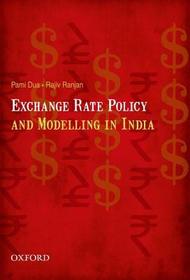
Exchange Rate Policy and Modelling in India
- Publisher's listprice GBP 27.50
-
12 416 Ft (11 825 Ft + 5% VAT)
The price is estimated because at the time of ordering we do not know what conversion rates will apply to HUF / product currency when the book arrives. In case HUF is weaker, the price increases slightly, in case HUF is stronger, the price goes lower slightly.
- Discount 10% (cc. 1 242 Ft off)
- Discounted price 11 175 Ft (10 643 Ft + 5% VAT)
Subcribe now and take benefit of a favourable price.
Subscribe
12 416 Ft

Availability
Only to order.
Why don't you give exact delivery time?
Delivery time is estimated on our previous experiences. We give estimations only, because we order from outside Hungary, and the delivery time mainly depends on how quickly the publisher supplies the book. Faster or slower deliveries both happen, but we do our best to supply as quickly as possible.
Product details:
- Publisher OUP India
- Date of Publication 5 April 2012
- ISBN 9780198077206
- Binding Hardback
- No. of pages272 pages
- Size 222x145x24 mm
- Weight 440 g
- Language English 0
Categories
Short description:
This book provides a comprehensive analysis of the foreign exchange market in India in terms of participants, instruments and the trading platform, as also turnover and forward premia. It examines the role of exchange rates in the recent global financial crisis, and also develops an alternative forecasting model for the rupee-dollar exchange rate.
MoreLong description:
Exchange rate fluctuations affect the value of international investment portfolios, competitiveness of exports and imports, value of international reserves, currency value of debt payments, and the cost to tourists in terms of the value of their currency. Movements in exchange rates, therefore, have significant implications for the economy's business cycle, trade, and capital flows. This book provides a comprehensive analysis of the foreign exchange market in India in terms of participants, instruments and the trading platform, as also turnover and forward premia.
The book covers four broad areas: (i) various facets of economic policy with respect to the exchange rate; (ii) the recent global financial crisis and the role of exchange rates therein; (iii) the pattern of capital flows and capital account liberalization; and (iv) modelling and forecasting the exchange rate. The authors contextualize the evolution of the Indian foreign exchange market from a highly regulated market to a deep, liquid, and efficient market in the 1990s, and focus on how large capital flows have impacted the exchange rate policy. More important, they develop a model for the rupee-dollar exchange rate taking into account variables from monetary and micro structure models as well as other variables such as central bank intervention.
Table of Contents:
Introduction
Exchange Rate Regimes
Exchange Rate and Exchange Rate Policy
Foreign Exchange Market Structure and Turnover
Manifestations of the Global Financial Crisis
Approach to Capital Account Liberalization
Capital Flows and Central Bank Intervention in the Foreign Exchange Market
Modelling and Forecasting the Exchange Rate
Concluding Observations
Annexure
Data Definition and Sources
References
Index

