

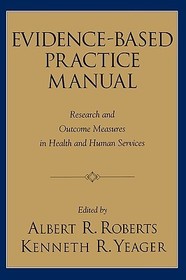
Evidence-Based Practice Manual
Research and outcome measures in health and human services
- Publisher's listprice GBP 135.00
-
60 952 Ft (58 050 Ft + 5% VAT)
The price is estimated because at the time of ordering we do not know what conversion rates will apply to HUF / product currency when the book arrives. In case HUF is weaker, the price increases slightly, in case HUF is stronger, the price goes lower slightly.
- Discount 10% (cc. 6 095 Ft off)
- Discounted price 54 857 Ft (52 245 Ft + 5% VAT)
Subcribe now and take benefit of a favourable price.
Subscribe
60 952 Ft

Availability
printed on demand
Why don't you give exact delivery time?
Delivery time is estimated on our previous experiences. We give estimations only, because we order from outside Hungary, and the delivery time mainly depends on how quickly the publisher supplies the book. Faster or slower deliveries both happen, but we do our best to supply as quickly as possible.
Product details:
- Publisher OUP USA
- Date of Publication 12 February 2004
- ISBN 9780195165005
- Binding Hardback
- No. of pages1080 pages
- Size 262x185x54 mm
- Weight 2037 g
- Language English
- Illustrations numerous figures and tables 0
Categories
Short description:
The Evidence-Based Practice Manual was developed as an all-inclusive and comprehensive practical desktop resource. It includes 104 original chapters, each specially written by the most prominent and experienced medical, public health, psychology, social work, criminal justice, and public policy practitioners, researchers, and professors in the United States and Canada. This book is specifically designed with practitioners in mind, providing at-a-glance overviews and direct application chapters. This is the only interdisciplinary volume available for locating and applying evidence-based assessment measures, treatment plans, and interventions. Particular attention has been given to providing practice guidelines and exemplars of evidence-based practice and practice-based research.
MoreLong description:
The Evidence-Based Practice Manual includes 104 original chapters, each specially written by the most prominent and experienced medical, public health, psychology, social work, criminal justice, and public policy practitioners, researchers, and professors in the United States and Canada. This book is specifically designed with practitioners in mind, providing at-a-glance overviews and direct application chapters. This is the only interdisciplinary volume available for locating and applying evidence-based assessment measures, treatment plans, and interventions. Particular attention has been given to providing practice guidelines and exemplars of evidence-based practice and practice-based research.
The Evidence-Based Practice Manual emphasizes and summarizes key elements, issues, concepts, and how-to approaches in the development and application of evidence-based practice. Discussions include program evaluation, quality and operational improvement strategies, research grant applications, validating measurement tools, and utilizing statistical procedures. Concise summaries of the substantive evidence gained from methodologically rigorous quantitative and qualitative research provide make this is an accessible resource for a broad range of practitioners facing the mandate of evidence-based practice in the health and human services.
This manual represents a significant and timely step in our further efforts to establish a base for understanding and promoting the efficacy of social work practice. Both social work practitioners and social work educators will find the studies broadly representative of the field, research methodologies, and our attempts toward greater accountability in social work practice.
Table of Contents:
Section I: Overview and critical issues
Systematic reviews of evidence-based studies and practice-based research: how to search for, develop, and use them
Implementing best practice and expert consensus procedures
Overview of evidence based practices
Informing health choices: reflections on knowledge integration strategies for electronic health records
Toward common performance indicators and measures for accountability in behavioural health care
An overview of focus group interviewing
Mental illness, substance dependence and suicidality: secondary data analysis
Making participant observation research matter: a typology based on 12,000 felons
Computer technology and social work
Problem formulation, conceptualization, and theory development
Statistics for human service workers
Section II: Research ethics and step-by-step research grant guidelines
Methodological, practical and ethical challenges to inner-city health research
Qualitative research ethics: thriving within tensions
The fine art of grantsmanship
Applying for research grants: step-by-step guidelines
Setting the stage for accountability and program evaluation in community-based grant-making
Conducting cost-benefit analysis in human service settings
Section III: Evidence-based practice: diagnosis, interventions, and outcome research
Concise standards for developing evidence-based practice guidelines
Health care evidence-based practice: a product of political and cultural times
Facilitating practitioner use of evidence-based practice
Implementation of practice guidelines and evidence-based treatment: a survey of psychiatrists, psychologists and social workers
Measuring skills and reasoning scientifically and critically about practice
Task centered practice: an exemplar of evidence-based practice
Treatment evidence in a non-experimenting practice environment: some recommendations for increasing supply and demand
Evidence-based practice and manualized treatment with children
Evidence-based treatment for traumatized and abused children
Treating juvenile delinquents with Conduct Disorder, ADHD, and Oppositional Defiance Disorder
Evidence-based treatments for Obsessive Compulsive Disorder (OCD): deciding what treatment method works for whom?
The implications of controlled outcome studies on planned short-term psychotherapy with depressive disorders
Evidence-based practice with anxiety disorders: guidelines based on 59 outcome studies
Cognitive Behavioral Therapy of persons with PTSD: an evidence-based approach
Evidence-based life skills interventions for pregnant adolescents in school settings
Evidence-based practice with EMDR
Dysthymic disorder and the college student: evidence-based mental health approach
Implementing evidence-based practices in Opioid Agonist Therapy (OAT) clinics
Evidence-based couples therapy with depressed clients
Section IV: Epidemiological and public health research
Epidemiology basics and foundation skills
Application of remote sensing for disease surveillance in urban and suburban areas
Establishing collaborations that engender trust in the prevention of sexually transmitted diseases
Prevalence of smoking and cessation among Northern Plains Indians
Using evaluation data as the basis for a local ordinance to control alcohol and tobacco billboards in Chicago
Use of random digit dialing to recruit representative population samples: epidemiological case control studies
Section V: Conceptualization, operationalization, and measurement
Measuring and evaluating effectiveness of services for families and children
Risk adjusted mental health outcomes
Validity and reliability in family assessment
Statistical methods for estimates of inter-rater reliability
Elements of consumer based outcome measurement
Using computer technology in the measurement and prevention of college drinking
Section VI: Assessment tools and measures
Locating measurement tools and instruments for individuals and couples
Overview of health scales and measures
Clinician and patient satisfaction with computer-assisted diagnostic assessment in community outpatient clinics
Psychosocial measures for Asian Pacific Americans
Crisis assessment measures and tools
Outcome measurement scale with families of the seriously mentally ill
Constructing and validating assessment tools for school based practitioners: The elementary school successful profile
PTSD and trauma assessment scales
Diagnosis and assessment of comorbid Oppositional Defiance Disorder and Obsessive Compulsive Disorder
Assessment measures for sexual predators: step-by-step guidelines
'Optimal practice' clinical neuropsychology: a cautionary tale and revisionist proto-model
Development of the fatherhood scale
Constructing and validating a specific multi-item assessment or evaluation tool
Section VII: Program evaluation strategies
Empowerment evaluation
The seven secrets of a successful veteran evaluator
Integrating program evaluation and organization development
Process vs. outcome evaluation
Data quality for international service evaluation
The data whisperer: strategies for motivating raw data providers
Needs assessment: a step-by-step approach
Budgeting and fiscal management in program evaluations
Constructing and using logic models in program evaluation
Program evaluation: this is rocket science
The evaluation of training for Leaders of foster and adoptive parent support groups
Documenting change in addiction treatment systems: a model for evaluation and examples of its use
Innovative approaches to risk assessment within alcohol prevention programming
Section VIII: Practice-based qualitative research exemplars
Qualitative evaluation application of reflective practice in direct care settings
Qualitative research with battered women: a continuum based on 501 cases
Using qualitative research to enhance practice: the example of breast cancer in African American women
Qualitative research: cancer prevention in older women
How family members of the mentally ill view mental health professionals: a focused ethnography
Death on a daily basis: integrating research and practice in support groups for ICU nurses in Southern Brazil
Family status and soup kitchen use: some policy considerations based on qualitative research findings
Section IX: Practice-based quantitative research exemplars
A cognitive behavioural approach to suicide risk reduction in crisis intervention
Effects of restorative justice on fear of revictimization: a meta-analysis using hierarchical generalized linear models
Factors associated with crime on the casino floor: implications of secondary data analysis
Homicides in older women in New York city: a profile based on secondary data analysis
Effective outcomes management at Deveraux
Developing treatment programs for drug courts and evaluating effectiveness
Application of logic models in rural program development
Amplifying performance measurement literacy: reflections from the Appalachian Partnership for Welfare Reform
HIV prevention: evidenced-based practice with infrastructure support
Community reintegration pre-release research exemplar: applying theory to practice-based research
Principles, practices and findings of the St. Louis vonundrum: a large-scale field experiment with anti-social children
Measuring police and citizen perceptions of police power in Newark, New Jersey
The role of families in buffering stress in persons with mental illness: a correlational study
Cognitive rehabilitation and neuronal plasticity: research on the effectiveness of quantitative EEG biofeedback
Section X: Establishing, monitoring and maintaining quality and operational improvement
Framework for institutionalizing quality assurance
Application of quality management methods for preventing an adverse event: the case of falls in hospitals
Establishment and utilization of balanced scorecards
Strengthening practice through results management
Measuring clients perception as outcome measurement
Social work role in disease management
Establishing benchmark programs within addictions treatment
Establishment of quality programming
Section XI: Epilogue
The clinical utility of mental health research: bridging the present to the future
Appendices
Internet resources on research and evaluation in healthcare and human service settings
Glossary

