

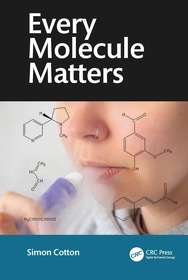
Every Molecule Tells a Story
-
GET 10% OFF
- Publisher's listprice GBP 96.99
-
46 336 Ft (44 130 Ft + 5% VAT)
The price is estimated because at the time of ordering we do not know what conversion rates will apply to HUF / product currency when the book arrives. In case HUF is weaker, the price increases slightly, in case HUF is stronger, the price goes lower slightly.
- Discount 10% (cc. 4 634 Ft off)
- Discounted price 41 703 Ft (39 717 Ft + 5% VAT)
41 703 Ft

Availability
Estimated delivery time: In stock at the publisher, but not at Prospero's office. Delivery time approx. 3-5 weeks.
Not in stock at Prospero.
Why don't you give exact delivery time?
Delivery time is estimated on our previous experiences. We give estimations only, because we order from outside Hungary, and the delivery time mainly depends on how quickly the publisher supplies the book. Faster or slower deliveries both happen, but we do our best to supply as quickly as possible.
Product details:
- Edition number 2
- Publisher CRC Press
- Date of Publication 30 March 2026
- ISBN 9781032615523
- Binding Hardback
- No. of pages348 pages
- Size 234x156 mm
- Weight 800 g
- Language English
- Illustrations 471 Illustrations, black & white; 1 Halftones, black & white; 470 Line drawings, black & white; 5 Tables, black & white 699
Categories
Short description:
This latest edition continues the celebration of molecules responsible for the experiences of everyday life. It presents new sections, notably the chemistry of molecules in food, and also covers developments such as the chemistry of drugs. This book brushes away any preconceived notions about chemistry to demonstrate its importance.
MoreLong description:
Every Molecule Tells a Story, Second Edition continues the celebration of molecules responsible for the experiences of everyday life: the air we breathe, the water we drink, the chemicals that fuel our living, the steroids that give us sex, the colours of the seasons, the drugs that heal us, and the scented molecules that enrich our diet and our encounters with each other. You can’t see them, but you know that they are there. This latest edition presents new sections, including odorants, including their potential in the diagnosis of diseases and the possibility that they may improve our memory. Environmental issues appear, such as air pollution – both outdoors and indoor – and the need for recycling of plastics. It does not pass over the dangers of some chemicals, whether abused drugs, for example oxycodone and the fentanyls, or nerve agents, notably the Novichoks. Based on the highly successful first edition, this book brushes away any preconceived notions about chemistry to demonstrate its importance.
Key Features
- The author introduces his molecular collection by explaining the relevance of chemistry in our everyday lives.
- New discoveries are reflected in existing chapters.
- The chemicals are frequently put in context of their human associations, so that the book goes beyond just ‘the chemistry’.
- A celebration of the molecules of chemistry.
Overview
This compilation is an essential reference work for every chemist – particularly organic chemists. It is a handbook of up-to-date knowledge on many of the chemical compounds in our chemical world, and their contexts. Not only is each chapter full of fascinating facts, but each chapter examines the molecules from a different perspective. Here, this reviewer provides commentaries on each of the chapters.
Chapter 1: Food
What differentiates this book from others that cover the topic of food is that, upfront Dr. Cotton discusses the taste of foods: “So the core of this chapter is to consider molecules responsible for flavour sensations in a range of foods, both cooked and uncooked “. This topic is especially relevant to those who, through chemotherapy, or though viral infections, lose their ability to experience the food sensations.
According to Dr. Cotton, roast beef has been the most studied, the delightful smell (to most carnivores) coming primarily from: methional, 2-acetylthiazole, and 2- acetylthiazolidine, 2-ethyl-3,5-dimethylpyrazine, and 2,3-diethyl-5- methylpyrazine. While fried chicken exudes a completely different array of complex molecules. Eye-opener for this reviewer!
The diversity of odiferous molecules from different cheeses was also fascinating, as were those from the baking process. Vegetarians and vegans need not despair as there are many, many, pages on odours from raw and cooked vegetables and fruit.
Chapter 2: Vitamins
As Dr. Cotton notes in the introduction, vitamins are “are an untidy collection of complex organic nutrients.” This chapter is built around the discovery of vitamins, particularly through the diseases they prevented. In the descriptions, exceptional care has been taken to accord the correct attributions of discovery and the discovery process. Then follows a detailed discussion of every vitamin and its chemistry.
Chapter 3: Spices, ‘Hot’ and ‘Cold’
After the usual outstanding historical background to the discovery and spread of spices around the world, Dr. Cotton focusses upon their mode of action. This includes very useful facts, including: “Much of a capsaicinoid molecule is hydrophobic and so not water-soluble, which is why reaching for the water jug or a beer is not the answer to a curry that is too hot for you; it is thought that milk is the best option, as it contains the lipophilic casein, which is better at removing the lipid-like capsaicins”.
Chapter 4: Abused Painkillers and other Drugs of Abuse
This chapter commences with a lengthy – and fascinating – discourse on the history of opium [“a mixture that involves over 20 different alkaloid molecules”] and its wide acceptance: “As an over-the-counter cure-all, it was the equivalent of aspirin a century later for many people - but better. It was a painkiller, a sedative and a specific treatment for diarrhoea”.
Dr. Cotton has a superlative coverage of fentanyl and its many derivatives. He describes the incredible toxicity of the fentanyl family requiring the wearing of hazmat suits when handling even the smallest dose. He also describes its probable use to break the 2002 siege by Chichen terrorists of 900 people in the Dubrovka Theatre in Moscow, by pumping an aerial suspension into the ventilation system of the Theatre and then treating as many as possible of the hostages with fentanyl antagonists. It is such unusual fact and applications which makes this compilation so interesting.
There is also a lengthy coverage of oxycodone and its relatives, including “Krokodil”, and many other addictive drugs.
Chapter 5: Nasty Smelling Molecules
What an unusual – but very appropriate – chapter title for an academic book! It is, of course, a focus upon molecules with high vapour pressure containing nitrogen and/or sulfur atoms. Again, Dr. Cotton surprises the reader by a lengthy – and absorbing – discourse on truffles: “The black truffle produces some 80 volatile molecules, including a lot of aldehydes, ketones and esters”. Then, a digression on :”the smelliest plant in the world, the titan arum Amorphophallus titanum. It flowers irregularly, every few years, and then just for two or three days. … The [rotten-flesh] smell helps it to attract the kind of insects, which like to feed on decaying flesh - flies and carrion beetles – whilst its deep red inflorescence looks like meat. The titan arum and several others that produce the rotting flesh smell owe their odour to mixtures of dimethyl disulphide and dimethyl trisulphide.”
Chapter 6: War and Peace in Nature
And what curiosities does the reader find in this chapter? Surely the section on plant defences is the most fascinating. As Dr. Cotton remarks: “Plants are at the bottom of the food chain. Though it sounds like confused biology to use the expression, they seem like sitting ducks. Vulnerable, yes, but they have a range of tricks up their sleeves to defend themselves against predators” – many of which Dr. Cotton describes..
Of course, insects with their mobility, have an amazing array of defensive and offensive options. One of the many amazing examples is: “Soldier termites of the Australian species Nasutitermes exitiosus do something even more complicated; they have been described by the authors of the book ‘Secret Weapons’ as ‘mobile artillery units’. They fire their weapon from a gland on their heads, not their abdomens, but again it can be directed, ahead; to the sides; and even behind them.”
Chapter 7: Organochlorine Compounds
Dr. Cotton ends this chapter with what might be more appropriate as an opening statement: “The world contains an amazing variety of organochlorine compounds – some are ‘natural’, some wholly synthetic. Some of these compounds are toxic or harmful in other ways, but others are not just useful substances but quite safe into the bargain. Molecules are ‘morally neutral’; they do not display their good or bad sides until they come into contact with people”. This chapter opens with a lengthy and detailed coverage of the history of DDT’s ‘rise and fall.’ Then amongst other compounds, he describes the large number of the fungal-derived chloro-antibiotics, where they were found and their amazing complex structures.
Chapter 8: Organofluorine Compounds
To begin this chapter, Dr. Cotton discusses in depth how, though fluorine and chlorine are in the same Periodic Table Group, difference in bond energies and electronegativities lead to some very different behaviour and properties in analogous compounds. About half the chapter is consumed by an in-context discussion of chlorofluorocarbons. Then PFOS and its family are covered, followed by fluoro-anesthetics, and fluoro-pharmaceuticals.
Chapter 9: Smoking and Vaping
Opening this chapter is a fascinating detailed of the history of smoking tobacco around the world. As usual, the account is sprinkled with asides that make this book such a fascinating read: “But the practice of cigarette smoking did not catch on at once [in Britain], until the American invention (Virginia, again) of the cigarette making machine in 1880, which chopped cigarettes from a tube of paper-wrapped tobacco, and which could make up to 212 cigarettes per minute”. Dr. Cotton then enters the incredibly complex world of vaping, which he tells us at the beginning: “A Chinese pharmacist named Hon Lik is often given the credit for inventing the precursor of the modern devices in 2003, as an aid to stopping smoking, after his father died of lung cancer (Spoiler: Hon Lik still smokes)”.
Chapter 10: Isotopes at Work
Commencing with a review of the history of isotope coverage, Dr. Cotton then reviews some of the isotope relevance of hydrogen, lead, uranium, and others. Of course, we can rely on Dr. Cotton to find some fascinating information which few would know. In this case, the selling of synthetic vanilla as expensive “natural vanilla.” He explains: Plants make vanillin via a biochemical pathway that results in a higher 13C/12C ratio than that found in synthetic vanillin, … . But the counterfeiters got round this by putting vanillin molecules with extra 13C into their fraudulent ‘vanilla extract’, so that their vanillin samples matched the “natural” ratio.” Nevertheless, the fake vanilla extract can still be identified, as Dr. Cotton explains: “Carbons outside the aromatic ring are easier to introduce; because of this chemical inequivalence between the carbon atoms in the aromatic ring and those carbon atoms that are substituent groups, the distribution of the 13C atoms in ‘faked’ vanillin is non-uniform, with greater numbers in the aldehyde and methoxy substituent positions.”
In summary
This book represents a life-time of accumulated knowledge by Dr. Cotton of chemistry in the real world. This includes many more anecdotes and asides than are selected here. Sprinkled through the chapters are the chemicals structures and many reaction mechanisms. For an organic chemist, these provide a greater depth of comprehension. Should the reader not be so inclined, the text alone is worth the cost of this book. The reader cannot claim to be truly knowledgeable about the chemistry of the world we live in, unless they have read this book and retained it as an ever-ready reference source.
Geoff Rayner-Canham, F.R.S.C., F.C.I.C.
Grenfell Campus, Memorial University Corner Brook, Newfoundland, Canada
In a continuation of Simon Cotton’s 2012 “Every Molecule Tells a Story,” his new book, “Every Molecule Matters”, covers in great detail the story of Food, Vitamins, Hot and Cold, Abused Pain Killers and Other Drugs of Abuse, Nasty Smells, War and Peace, Organochlorine Compounds, Organofluorine Compounds, Smoking and Vaping, Isotopes, and Methane. Each chapter is replete with extensive historical facts, chemical structures and origins, and present day situations. Each chapter has a detailed bibliography at the end of the volume.
The chapter, Spices, ‘Hot’ and ‘Cold,’ explains in fascinating detail the chemistry and biology of Capsaicin (“Hot”) and Menthol (“Cold”), and the evolution of these chemicals from antiquity to modern times. Also covered are the lesser known “Spice Chemicals” Nutmeg, Black Pepper, Cinnamon, Szechuan Peppers, and more.
Nasty Smelling Molecules is a fascinating exploration of the chemicals with which every human and animal species is familiar! In addition to the ubiquitous Indole and Hydrogen Sulfide, Cotton presents a myriad of other sulfur compounds from a variety of sources and discusses in detail the origin of the ‘Scent of Death’ heterocyclic amines.
Abused Painkillers and Other Drugs of Abuse reveals the evolution of the widely abused Heroin, Fentanyl, and Oxycontin, and presents the lesser known Spice and Nitazenes. The extraordinary toxicity of Fentanyl analogues, such as Sufentanil and Carfentanil, is outlined in alarming detail. The Nitazenes came to prominence in 2019 as new analgesics, more potent then morphine, but now recognized to have fatal toxicities comparable to fentanyl.
Vitamins is a marvelous presentation of the myriad vitamins that humans ingest daily. From the connection of scurvy to the lack of Vitamin C, to rickets to the lack of Vitamin D, and pellagra to the absence of Vitamin B3 (niacin), this chapter is a marvelous presentation of the history, sources, and function of all 18 vitamins.
Food is a wonderful summary of food types, from their constituents (protein, lipids, carbohydrates) to both fresh and cooked foods, fruits and vegetables, cheeses, and their myriad aromas. All of this is combined with enough organic chemistry to satisfy the professional (e.g., aroma structures, thermal reactions, oxidation and enzymatic chemistry).
War and Peace in Nature concisely summarizes the extraordinary chemistry utilized by plants and insects in chemical defense against potential predators (man, birds, animals, other insects). These repellent “allomones,” “alarm pheromones,” and natural insecticides comprise an array of volatile organic compounds, some of which are well known (benzoquinone, hydrogen peroxide, acetic acid, hydrogen cyanide, volatile aldehydes, phenols) and others such as piperidines, pyrethrins, and the “blister beetle” cantharidin are new to science. Interestingly, one of these piperidines is a close analogue to the poison hemlock alkaloid that killed Socrates. The well-known plant alkaloids caffeine, cocaine, morphine, and nicotine are toxic to insects. Organic chemistry is limited to the structures of these compounds and some of the fascinating routes to their formation.
Organochlorine Compounds is a chapter dear to me! I’ve been following and documenting organochlorine compounds found in nature for the past 45 years. Dr. Cotton concisely presents an account of both man-made and natural organochlorine compounds. From the Civil War anesthetic chloroform and the life-saving vancomycin to the pesticides DDT and Dieldrin, this short chapter succinctly covers this enormous field. A highlight is the sex pheromone 2,6-dichlorophenol produced by species of female ticks. Interestingly, this isomer is essentially impossible to prepare in the laboratory because chlorination of phenol gives the 2,4-isomer! Other relevant examples are the chemical defensive secretion epibatidine, which is a rare chloropyridine, and the soil antibiotic chlorotetracycline. The presentation of organic structures is minimal and appropriate.
Organofluorine Compounds is arguably the most important chapter in the book. It deals with the two current “hot” topics of CFCs (chlorofluorocarbons) and PFAS (polyfluorinated alkyl substances) — the former in great detail with respect to the ozone layer and the latter fleetingly. Coverage of CFCs (historical, evolution, chemistry, consequences) is the most detailed and comprehensive that I have ever seen! The rare natural organofluorine and highly toxic compound, fluoroacetic acid, and some fluorinated pharmaceuticals are covered briefly.
Smoking and Vaping. Following an Introduction to the use of tobacco dating back to perhaps 18,000 years ago and certainly used by people in the Andes during 3000-5000 BC, the chapter focusses on the adverse health effects of smoking tobacco. These include formation of the ubiquitous polycyclic aromatic hydrocarbons and N-nitrosoamines. The section on the relatively new addiction of Vaping (via e-cigarettes) includes the fascinating chemical formation of various toxic compounds (acrolein, other aldehydes) and other compounds from the flavoring additives such as diacetyl (“popcorn aroma”). Presented also is the surprising generation of higher reactive (and presumed toxic) ketene from Vitamin E acetate. The virtually unknown effects of metals and alcohols, which are present in e-cigarettes, are disclosed. The chapter closes with an illuminating “Conclusions and Summary.”
Isotopes At Work. In what is an enormous area comprising hundreds of isotopes, Dr. Cotton concentrates this chapter on a few of the most relevant isotopes. Beginning with definitions and familiar examples (“heavy water,” radioactive vs. non-radioactive, uranium and carbon isotopes), a major attraction of this chapter is the use of isotopes in food fraud, carbon dating, criminology, and forensic science, one case of which analyzed the skeleton of King Richard III. Also presented are “Isoscapes,” the new study of lighter isotopes.
Methane. The simplest organic molecule is methane (one carbon atom bonded to three hydrogen atoms). In this concise chapter Dr. Cotton presents the astonishing natural occurrences of methane in our universe, and its role in the “Greenhouse Effect” leading to global warming. No chemistry is explicitly depicted.
Bibliography Dr. Cotton has assembled a Bibliography of nearly 60 pages that covers each book chapter. From book references to primary literature citations, this is a wealth of information for the reader. References include both classic reviews and modern journal citations. Several references to the 2024 literature are listed. For example, the Food chapter lists nearly 170 references. This document alone is worth the price of the book!
Gordon W. Gribble, Professor of Chemistry Emeritus, Department of Chemistry, Dartmouth College, Hanover, New Hampshire, USA.
More
Table of Contents:
Preface. About The Author. Chapter 1: Atmosphere and Water. Chapter 2: Carbohydrates and Artificial Sweeteners. Chapter 3: Hydrocarbons. Chapter 4: Acids and Alkalis. Chapter 5: Steroids and Sex. Chapter 6: The Senses. Chapter 7: Cosmetics and Perfumes. Chapter 8: Natural Killers. Chapter 9: Unnatural Killers. Chapter 10. Chapter 11: Pleasure Molecules. Chapter 12: Natural Healers. Chapter 13: Man-Made Healers. Chapter 14: Synthetic Polymers. Bibliography. Index
More
