

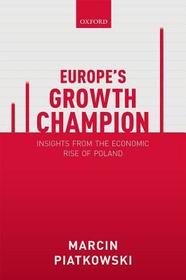
Europe's Growth Champion
Insights from the Economic Rise of Poland
- Publisher's listprice GBP 122.50
-
58 524 Ft (55 737 Ft + 5% VAT)
The price is estimated because at the time of ordering we do not know what conversion rates will apply to HUF / product currency when the book arrives. In case HUF is weaker, the price increases slightly, in case HUF is stronger, the price goes lower slightly.
- Discount 10% (cc. 5 852 Ft off)
- Discounted price 52 671 Ft (50 163 Ft + 5% VAT)
Subcribe now and take benefit of a favourable price.
Subscribe
58 524 Ft

Availability
Permanently out of stock
Why don't you give exact delivery time?
Delivery time is estimated on our previous experiences. We give estimations only, because we order from outside Hungary, and the delivery time mainly depends on how quickly the publisher supplies the book. Faster or slower deliveries both happen, but we do our best to supply as quickly as possible.
Product details:
- Publisher OUP Oxford
- Date of Publication 8 March 2018
- ISBN 9780198789345
- Binding Hardback
- No. of pages392 pages
- Size 242x164x30 mm
- Weight 734 g
- Language English 0
Categories
Short description:
Poland is one of the biggest yet rarely heard of economic success stories. Over the last twenty-five years it has unexpectedly become Europe's growth champion. This book is about lessons learned from Poland's remarkable experience, the conditions that keep countries poor, and challenges the countries face to grow.
MoreLong description:
What makes countries rich? What makes countries poor? Europe's Growth Champion: Insights from the Economic Rise of Poland seeks to answer these questions, and many more, through a study of one of the biggest, and least heard about, economic success stories.
Over the last twenty-five years Poland has transitioned from a perennially backward, poor, and peripheral country to unexpectedly join the ranks of the world's high income countries. Europe's Growth Champion is about the lessons learned from Poland's remarkable experience, the conditions that keep countries poor, and the challenges that countries need to face in order to grow. It defines a new growth model that Poland and its Eastern European peers need to adopt in order to continue to grow and catch up with their Western counterparts.
Europe's Growth Champion emphasizes the importance of the fundamental sources of growth– institutions, culture, ideas, and leaders– in economic development. It argues that a shift from an extractive society, where the few rule for the benefit of the few, to an inclusive society, where many rule for the benefit of many, was the key to Poland's success. It asserts that a newly emerged inclusive society will support further convergence of Poland and the rest of Central and Eastern Europe with the West, and help to sustain the region's Golden Age. It also acknowledges the future challenges that Poland faces, and that moving to the core of the European economy will require further reforms and changes in Poland's developmental character.
The clarity of the author's reasoning is in fact one of the book's greatest merits
Table of Contents:
Introduction
What are institutions and how do they drive economic growth?
From Black Death to black hole
What the Black Death was to Western Europe, Communism was to Central and Eastern Europe
Poland's transition success story
Drivers of Poland's successful transition
Fundamental sources of Poland's growth: The role of institutions
The role of culture, ideas, and leadership
Will Poland's success continue? Projections, scenarios, and risks
The new growth model for CEE: "The Warsaw Consensus"
Conclusions and the way forward

