

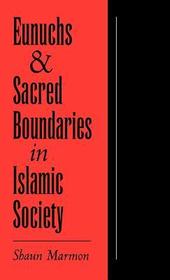
Eunuchs and Sacred Boundaries in Islamic Society
Series: Studies in Middle Eastern History;
- Publisher's listprice GBP 155.00
-
74 051 Ft (70 525 Ft + 5% VAT)
The price is estimated because at the time of ordering we do not know what conversion rates will apply to HUF / product currency when the book arrives. In case HUF is weaker, the price increases slightly, in case HUF is stronger, the price goes lower slightly.
- Discount 10% (cc. 7 405 Ft off)
- Discounted price 66 646 Ft (63 473 Ft + 5% VAT)
Subcribe now and take benefit of a favourable price.
Subscribe
74 051 Ft

Availability
printed on demand
Why don't you give exact delivery time?
Delivery time is estimated on our previous experiences. We give estimations only, because we order from outside Hungary, and the delivery time mainly depends on how quickly the publisher supplies the book. Faster or slower deliveries both happen, but we do our best to supply as quickly as possible.
Product details:
- Publisher OUP USA
- Date of Publication 18 January 1996
- ISBN 9780195071016
- Binding Hardback
- No. of pages176 pages
- Size 226x148x16 mm
- Weight 399 g
- Language English 0
Categories
Short description:
The figure of the eunuch in non-Western cultures has long been an object of mystery and mystification to the West. This book goes beyond sensationalism and stereotypes and offers a sensitive reconstruction of the historical role of the eunuch in Islam.
MoreLong description:
In this thought-provoking interdisciplinary work, Shaun Marmon describes how eunuchs, as a category of people who embodied ambiguity, both defined and mediated critical thresholds of moral and physical space in the household, in the palace and in the tomb of pre-modern Islamic society. The author's central focus is on the sacred society of eunuchs who guarded the tomb of the Prophet Muhammad in Medina for over six centuries and whose last representatives still perform many of their time honored rituals to this day. Through Marmon's account, the "sacred" eunuchs of Medina become historical guides into uncharted dimensions of Islamic ritual, political symbolism, social order, gender and time.
The book deals with some important aspects of sexuality and religion. Its scholarship is impeccable; Shaun Marmon has made an exhaustive study of Arabic sources, including many unpublished manuscripts and has used European sources in a wide variety of languages. She has interpreted these documents with the keenest historical imagination and reconstructed most vividly the events and institutions of that period. To my knowledge, this is the first and only systematic study on this particular subject.

